
Evolution story
California sheephead: the reef fish that changes sex from female to male
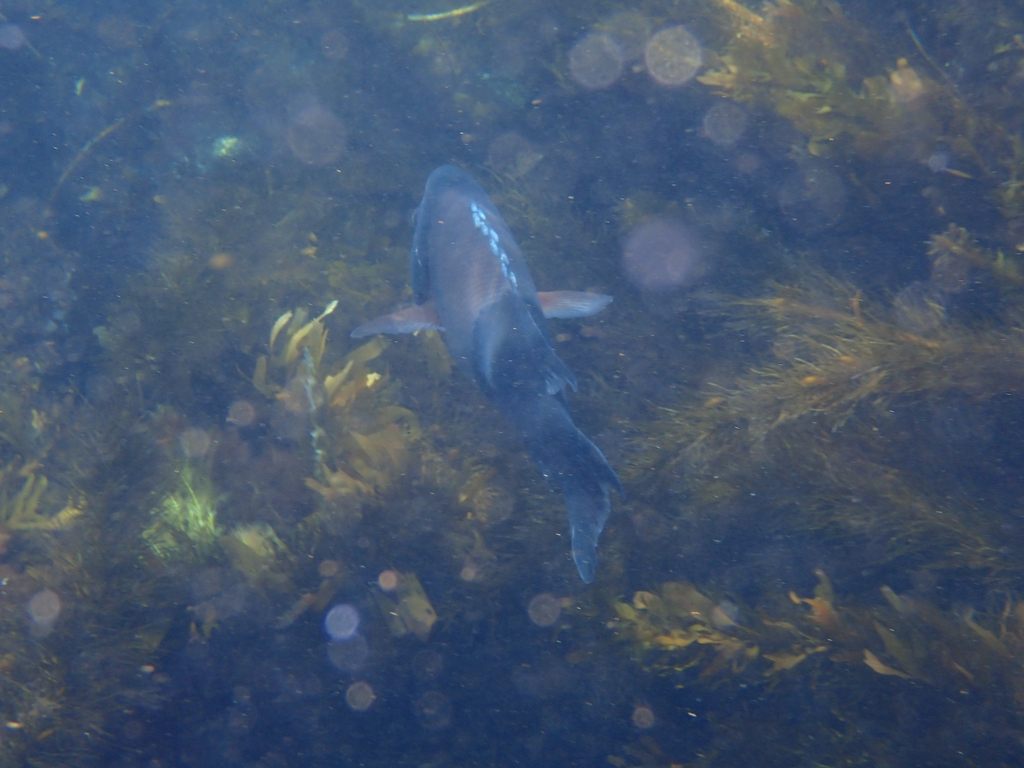
Every California sheephead (Bodianus pulcher) is born female. Living in small groups with a single dominant male, the largest female can switch sex if he disappears, turning fully male in as little as five days to two weeks. The change is one-directional and permanent, and it runs the opposite way to a clownfish's.
Drop below the kelp canopy off the coast of California and a large, oddly proportioned wrasse with a bulging forehead and heavy lips is one of the more unmistakable residents. It is also living proof that "male" and "female" are not fixed categories everywhere in the ocean. Every California sheephead starts life as a female, and which fish in a group eventually becomes male has nothing to do with anything decided at birth.
How to tell a sheephead's sex at a glance
Unusually for a fish, sex in Bodianus pulcher is written all over its colour. A juvenile is bright red-orange with a white stripe down its flank and a black spot near the tail. By around two years old it settles into adult female colouring: a uniform reddish pink body with a white chin. A male looks like a different species entirely: a black head, a black rear half and tail, a wide band of orange-pink across the middle, red eyes, and a fleshy bump on the forehead that grows more pronounced with age and size.
That size difference is not incidental. Males are consistently the largest fish in any group, because the fish that changes sex is always the largest, most dominant female available. There is no such thing as a small, young male sheephead.
Born female, every one of them
Biologists call this arrangement protogynous hermaphroditism, sequential hermaphroditism that runs female-first. A sheephead spends its early life entirely as a female, developing and functioning ovaries with no male tissue at all. Groups form loose harems on a patch of reef: one male, and a handful of females ranked roughly by size. As long as the male is present and healthy, every female in the group stays female indefinitely.
It is the mirror image of a clownfish, which is born male and can switch to female. Sheephead run the opposite direction, female to male, which makes the pair a useful before-and-after of how differently sequential hermaphroditism can be wired even among fish that all belong to the order Perciformes.
What triggers the switch, and how fast it happens
Remove the resident male, to a predator, a fishing line, or simply old age, and the largest female in the group responds within days. Her ovaries begin to degenerate while tissue capable of producing sperm develops in their place. Reported timelines for a full functional switch range from about five days to two weeks, fast enough that a reef survey can record a fish as female on one visit and male on the next. Once the transition completes, it does not reverse. A fish that becomes male stays male, and a female that never gets the chance to switch simply lives out her life as one.
The trigger is social, not seasonal: it is the absence of a male, not a time of year or a fixed age, that starts the process. That is exactly the same social logic driving the direction-reversed switch in the clownfish's sex change, even though the two species are swapping in opposite directions.
A keystone hunter of the kelp forest
None of this biology would matter much if the sheephead were not also doing serious ecological work. Its diet is built around hard-shelled prey: sea urchins above all, plus crabs, mussels, barnacles and other molluscs. Forward-facing canine teeth pull prey off the rock, and a second set of crushing teeth on a bony plate deep in the throat, the pharyngeal jaw, grinds shells and spines to fragments before the tissue is swallowed.
Sea urchins left unchecked can strip a kelp forest bare and leave behind an "urchin barren," a rocky seafloor with almost nothing left growing on it. By eating urchins in large numbers, the California sheephead acts as a keystone predator that helps keep that outcome from happening, playing a similar ecological role in California's kelp forests to the one sea otters play by hunting the same prey from the surface down.
Why size-selective fishing hits a sex-changing fish differently
California sheephead are targeted by both recreational spearfishing and commercial hook-and-line fishing, and here the biology creates a genuine management puzzle. Because males are always the largest fish in a group, any fishing method that selectively takes the biggest individuals removes disproportionately more males than females. Research on the species has shown that heavy removal of large males can push more females to switch sex earlier and at a smaller size to fill the gap, gradually shrinking the average size of both sexes in a fished population and reducing how many eggs a group can produce overall.
That is a straightforward fisheries-management fact rather than a comment on the species' status: it is exactly why size and slot limits exist for California sheephead, protecting a spread of both female and male fish rather than only the biggest catch. Sequential hermaphrodites like this one are simply more sensitive to size-based harvesting than a fish where every individual is one fixed sex for life.
How rare is the California sheephead in Kaught?
In the Kaught catalog the California sheephead sits at the Epic tier, three diamonds out of four. That is a measure of how often the species is actually logged in the wild, not a statement about its future. Sheephead live on rocky reefs and in kelp forests at diving depth, from Monterey Bay down to the Gulf of California, a narrow slice of coastline that most people never get below the surface of. A confirmed, photographed sighting takes a wetsuit and a dive, not a walk to the shoreline, which is exactly the kind of gap between "exists in large numbers" and "gets recorded" that pushes a species up the rarity scale.
Three things worth knowing about the California sheephead
- The genus name has shifted more than once. Older field guides list it as Semicossyphus pulcher; current classification places it in Bodianus, the same genus as many other tropical hogfish.
- A large male's forehead bump keeps growing with age and size, making the biggest, oldest males in a population instantly recognisable underwater even from a distance.
- Juveniles do not just look different, they eat differently too, picking off small tube-dwelling worms and tiny crustaceans before graduating to the sea urchins and crabs that define the adult diet.
Sequential hermaphroditism keeps turning up on the reef once you start looking for it, and it rarely runs the same way twice. The ribbon eel changes sex male to female like a clownfish, while the giant seahorse skips sex change altogether and hands pregnancy to the male instead. The sheephead's female-to-male switch is the rarer direction among reef fish, and, thanks to its size, the easiest of the three to actually watch happen.
California sheephead: frequently asked questions
Why do California sheephead change sex?
Every California sheephead is born female. They live in small groups with one dominant male; if he dies or is removed, the largest, most dominant female in the group switches sex to replace him, keeping the group's breeding structure intact.
Are California sheephead born male or female?
Female. California sheephead are protogynous hermaphrodites, meaning every individual starts life as a female and only some later switch to male. This is the opposite direction to clownfish, which are all born male.
Can a California sheephead change back to female?
No. The switch from female to male is one-directional and permanent. Once a fish has completed the transition, its ovaries have degenerated and its body produces sperm instead, and it remains male for the rest of its life.
How can you tell a male from a female California sheephead?
By colour. Females are a uniform reddish pink with a white chin. Males are larger, with a black head, a black rear half and tail, a bright orange-pink midsection band, red eyes, and a fleshy bump on the forehead.
What do California sheephead eat, and why does it matter for kelp forests?
Mainly sea urchins, crabs and molluscs, cracked open with forward canine teeth and a bony crushing plate in the throat. By keeping urchin numbers down, sheephead help stop urchins overgrazing kelp forests into barren rock.
Why does fishing affect sex-changing fish differently?
Because males are the larger, older fish, size-selective fishing removes disproportionately more males. That can trigger extra females to switch sex to fill the gap, shrinking the average size of both sexes over time.
Why is the California sheephead "Epic" in Kaught?
Kaught's rarity tier reflects how often a species is actually recorded in the wild, not its status. California sheephead live on rocky reefs at diving depth within a narrow stretch of the eastern Pacific, which makes a confirmed sighting genuinely uncommon: Epic, three diamonds out of four.
The next thing you see could be
your first catch.
Kaught is live on the App Store and Google Play. Free to start, and your first catch is one photo away.
Free to start · Live on the App Store and Google Play
Species data, type, rarity tier and measurements, is drawn from the Kaught catalog, built on open biodiversity records from GBIF and iNaturalist. Rarity reflects how often a species is observed in the wild, not its conservation status.