
Record holders
Best Sense of Smell in the Animal Kingdom: 6 Ranked
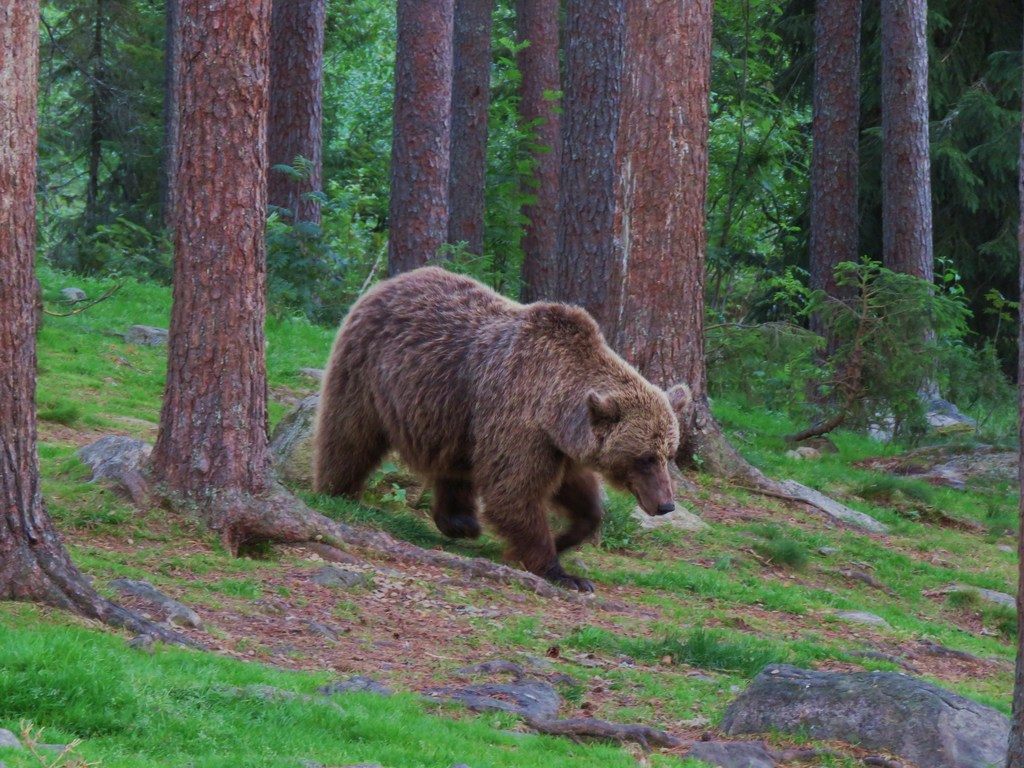
No single winner: a Brown Bear's nose may be thousands of times sharper than a human's, an African Savanna Elephant has more smell-receptor genes than any mammal, and a Polyphemus Moth can detect a mate kilometres downwind. Six real catalog species, ranked by the smell record each holds.
Smell is the oldest sense and, for most animals, the most trusted one. Where "best eyesight" or "fastest" can at least be measured on a shared scale, kilometres per hour or metres of visual range, smell resists a single unit. A bear tracking a carcass across a valley, a moth homing in on a single pheromone molecule and a salmon reading the chemical signature of a river it left years ago are all doing something that could fairly be called the best sense of smell alive, just for entirely different problems. The six animals below each hold a genuine, documented record, and every one is in the Kaught catalog with its observation-derived rarity tier.
1. Brown Bear, a nose built to work at kilometres
Ask a wildlife biologist which animal has the best nose and bears come up fast. A bear's skull holds an olfactory turbinate system, the scroll-like bones lined with scent-detecting tissue, that wildlife agencies estimate at roughly seven times the surface area of a bloodhound's relative to head size, feeding into an olfactory bulb disproportionately large for its brain. The commonly cited estimate, thousands of times more sensitive than a human's, is difficult to pin to an exact number, but the field evidence is not: bears reliably find buried carcasses, food caches and rendered fat from kilometres downwind, which is exactly why backcountry food canisters are built to be bear-resistant, not merely sealed.
That nose is a foraging tool first. A brown bear spends most of its waking hours locating berries, roots, fish and carrion across a huge home range, and smell does most of that work long before sight or hearing come into play. Legendary in the catalog, four diamonds: despite ranging across the entire Northern Hemisphere, a brown bear is genuinely difficult to observe, shy of people and often active at dawn, dusk or under forest cover.
2. African Savanna Elephant, the most smell-receptor genes of any mammal studied
Where the bear's record is field-observed, the elephant's is written straight into its DNA. A comparative genomics survey across mammals found the African savanna elephant carries roughly 2,000 functional olfactory receptor genes, more than double a dog's count and around five times a human's, the largest such repertoire ever measured in a mammal. Every one of those genes builds a receptor tuned to a different family of scent molecules.
In practice, that genetic toolkit lets an elephant track water sources across dry savanna, recognise individual family members by scent alone, and reportedly distinguish which human ethnic groups pose more risk based on the smell of clothing worn by each, a finding from field research in Kenya. The trunk itself, packed with roughly 100,000 muscle fascicles and no bone, doubles as a highly mobile sampling tool that sweeps scent up toward the sensory tissue in the skull. Epic in the catalog, three diamonds, reflecting how much ground a herd covers and how seldom that ground includes an easy human vantage point.
3. Turkey Vulture, one of the only birds that hunts by smell
Most birds barely smell at all, which is what makes the turkey vulture's record notable: the achievement is not raw sensitivity but the fact that it has a working sense of smell in the first place. It soars for hours on thermals, wings held in a shallow V and rocking gently from side to side, flying low enough over open country to catch the airborne scent of decay rising off a carcass long before it is visible.
That nose has a genuinely strange real-world use. Ethyl mercaptan, one of the gases released early in decomposition, is also the compound gas utility companies add to naturally odourless natural gas so leaks can be smelled by people. Turkey vultures respond to the same compound, and utility crews have used circling vultures as a low-tech way to spot pipeline leaks from the air. Common in the catalog, one diamond, it is a familiar sight soaring over farmland and roadsides from southern Canada to South America.
4. Atlantic Salmon, homing across an ocean by smell alone
An Atlantic salmon's record is not sensitivity but precision over distance. As a juvenile leaving its birth stream for the ocean, it chemically imprints the exact scent of that water, likely a specific blend of dissolved minerals and plant compounds unique to that stretch of river. Years later, having grown to adulthood thousands of kilometres away in the open Atlantic, it uses that stored scent memory to navigate back, first to the right coastline, then to the correct river mouth, then upstream to the precise tributary where it hatched.
Smell is only the final, most precise stage; magnetic-field sensing likely handles the ocean-scale navigation first. The full mechanism is covered in the salmon homing guide. Common in the catalog, one diamond, this species remains widespread across North Atlantic rivers despite the extraordinary difficulty of what each returning fish has just done.
5. Western Rattlesnake, a second nose in the roof of its mouth
A snake's flicking tongue is not tasting the air so much as sampling it. Each flick collects airborne and surface scent particles and delivers them to the vomeronasal organ, also called Jacobson's organ, a dedicated chemical-detection structure in the roof of the mouth that is entirely separate from the nostrils. It gives a western rattlesnake a second, independent smell system built specifically for tracking.
That system does real work after a strike. A rattlesnake often releases venomous prey immediately rather than holding on, then uses tongue-flicks alone to relocate the animal once it has fled and died, discriminating its own strike's scent trail from the surrounding environment with remarkable accuracy. Common in the catalog, one diamond, it ranges across rocky terrain, grassland and shrubland from British Columbia to Baja California.
6. Polyphemus Moth, a mate detected from kilometres downwind
The last record on this list belongs to the smallest animal by far. A male polyphemus moth's antennae are large, feathery structures called plumose antennae, built almost entirely to maximise surface area for scent receptors, tens of thousands of them, each tuned to a single pheromone molecule released by a female of the same species. The sensitivity is extraordinary: a concentration too faint for most instruments to register is enough to trigger a directed upwind flight toward the source.
Adult polyphemus moths have no functional mouthparts and never feed at all; the entire few days of adult life are spent finding a mate before it runs out. That single-purpose urgency is likely what pushed the sensitivity this far, from kilometres away, a female's presence registers as clearly as if she were standing next to him. Common in the catalog, one diamond, it is found in woodland, orchards and suburban gardens across North America.
Why "best sense of smell" depends on the job
Line these six noses up and there is no outright winner, because smell never evolves toward some abstract maximum, it evolves to solve whatever problem a species actually faces. The brown bear needs to find scattered, hidden food across a huge range. The elephant needs to map water, kin and threat from a genetic toolkit few mammals can match. The turkey vulture needs a sense almost no other bird bothered to keep. The salmon needs to find one exact river out of thousands. The rattlesnake needs to relocate prey it has already lost sight of. The moth needs to find one specific individual before its short life runs out. Each is the correct answer to a different question.
The same logic runs through the best eyesight in the animal kingdom ranking, where the record depends on light and distance rather than scent, and the wider animals with extreme senses roundup, which covers touch, hearing and electroreception. This week's wolverine adaptation guide is a good companion piece: wolverines rely on scent caching and marking to survive an Arctic winter, a smell-driven survival strategy built for cold rather than distance.
Best sense of smell: frequently asked questions
What animal has the best sense of smell in the world?
There is no single winner. Wildlife biologists estimate a brown bear's nose is thousands of times more sensitive than a human's, an African savanna elephant carries more smell-receptor genes than any mammal studied, and a polyphemus moth can detect a mate from kilometres away. Each solves a different problem.
Do bears really have a better sense of smell than bloodhounds?
Yes, by most estimates. A bear's olfactory turbinates, the scroll-like bones that hold scent-detecting tissue, are around seven times larger than a bloodhound's relative to skull size, which is why bear-resistant food canisters exist: an ordinary sealed container is not enough.
Why do turkey vultures find carrion so quickly?
Smell, not sight. The turkey vulture is one of the few birds with a well-developed sense of smell and flies low to catch the scent of decay rising off the ground. Gas utilities exploit this: they add a carrion-like odour to pipelines and watch for circling vultures to spot leaks.
How do salmon find the exact river they were born in?
Smell is the dominant cue. As a juvenile, an Atlantic salmon chemically imprints the precise scent of its home stream, then uses that stored memory, read from the water itself, to navigate back from thousands of kilometres away in open ocean.
Can snakes actually smell with their tongue?
Not quite. A snake's tongue collects airborne and surface scent particles and delivers them to the vomeronasal (Jacobson's) organ in the roof of its mouth, a second, dedicated smell system distinct from its nostrils, used to track prey along a scent trail.
How far away can a moth smell a mate?
Male polyphemus moths can detect a female's pheromone from kilometres downwind. Their large, feathery antennae carry tens of thousands of receptors tuned to that single scent molecule, sensitive enough to trigger a directed flight toward a source too faint for almost any instrument to register.
The next thing you smell could be
your first catch.
Kaught is live on the App Store and Google Play. Free to start, and your first catch is one photo away.
Free to start · Live on the App Store and Google Play
Species data, type, rarity tier and measurements, is drawn from the Kaught catalog, built on open biodiversity records from GBIF and iNaturalist. Rarity reflects how often a species is observed in the wild, not its conservation status.