
Exotic spotlight
Giant African Bullfrog: Africa's heaviest frog eats snakes and guards its young
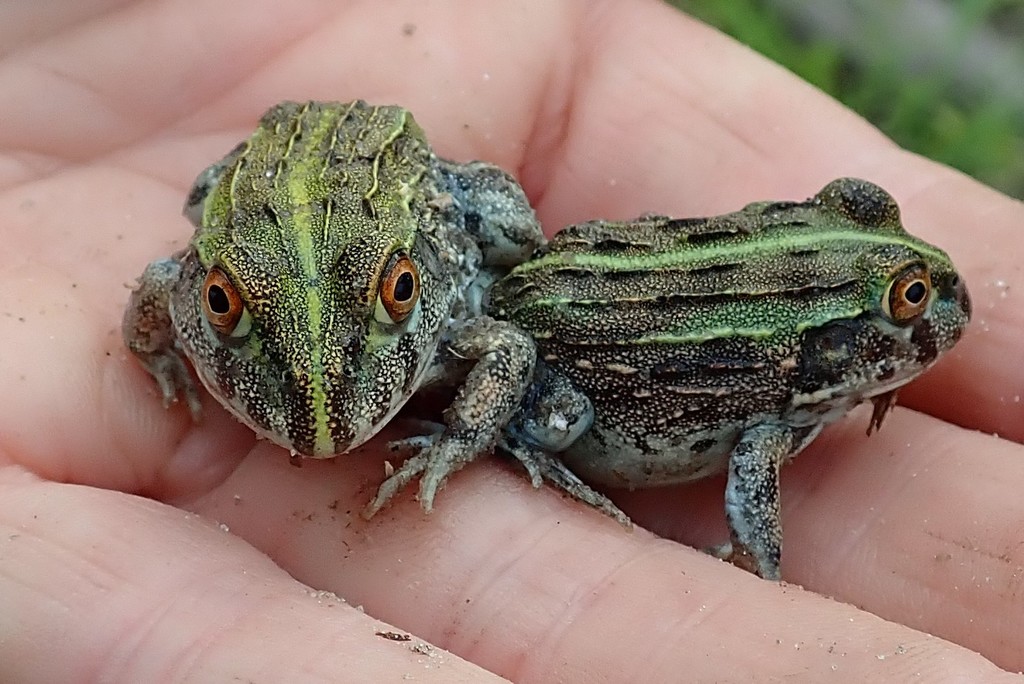
The giant African bullfrog (Pyxicephalus adspersus) is the largest frog in sub-Saharan Africa, with males reaching 23 cm and 1.4 kg. It ambushes snakes, eats anything that fits in its mouth, guards its tadpoles aggressively, and survives droughts by sealing itself underground in a mucous cocoon for months or years. Epic tier in the Kaught catalog.
Most frogs are quiet, cryptic and harmless. The giant African bullfrog is loud, conspicuous when it wants to be, and will bite a snake. It is one of the most behaviourally complex amphibians on the continent, and one of the least often seen, spending most of its life sealed underground in dry savanna.
How to identify a giant African bullfrog
Size is the first clue. A large male is unmistakable: the body is broad and squat, olive-green to yellowish-green above, with a pale or yellowish throat and belly. The skin is smooth rather than warty. Males carry a distinctive yellow or orange throat patch, visible even at a distance when they are calling.
The mouth is notably wide, and if you look carefully (from a safe distance) you can see the bony odontoid projections inside, ridges that function like blunt teeth for gripping struggling prey. A large male in defensive posture inflates its body, lowers its head and opens the mouth. This is not a bluff.
Females are much smaller, typically 12–15 cm and under half the weight of a large male. This male-biased size difference is the reverse of the usual pattern in frogs, where females are generally larger. In the giant African bullfrog, it reflects the fact that males fight each other for breeding pools, and bigger males win.
Range: dry Africa south of the Sahara
The giant African bullfrog lives in the drier parts of sub-Saharan Africa: savanna, open grassland and semi-arid scrub from South Africa and Zimbabwe north through Botswana, Namibia, Zambia, Tanzania and Kenya. It avoids closed canopy forest. The range overlaps substantially with the seasonal-rainfall zone, which is the key to understanding the frog's entire lifestyle.
A life timed to rain
For most of the year, a giant African bullfrog does not exist, at least not visibly. After rain events fill temporary pools, males emerge and congregate in their dozens or hundreds, calling loudly from the shallows. Breeding is explosive: females arrive, amplexus occurs, eggs are laid, and within a day or two the females leave. The males stay.
This is where the giant African bullfrog departs from almost every other African frog. The males guard the egg clutch and the pool of tadpoles that hatch. They drive off predators, including snakes and large birds. When a pool begins to dry faster than the tadpoles can develop, the male digs a channel between shrinking pools to allow the tadpoles to escape into deeper water. This is active engineering in service of offspring survival, unique among African anurans.
When the breeding season ends and the pools dry, every frog heads underground. The bullfrog burrows into damp soil and secretes multiple shed-skin layers around itself, forming a tight cocoon. Only the nostrils remain exposed. The animal enters aestivation, a dormant state similar to hibernation, and can remain entombed for months or, in severe droughts, several years until the next adequate rain triggers emergence.
What giant African bullfrogs eat
A sit-and-wait ambush predator. The frog positions itself at the edge of water or in grass, immobile, and explodes onto anything that moves within range: insects, beetles, small mammals, other frogs, lizards and snakes up to substantial size. The bite is powerful. Prey is pressed against the odontoid ridges and swallowed whole. There is no chewing and no venom. Speed and grip do the work.
In captivity, individuals have been documented consuming small rats, young birds and surprisingly large snakes. In the wild, puff adders and cobras feature in the diet of large males. The frog is not immune to snake venom but strikes fast and typically swallows before a coil can form.
Giant African bullfrog in the Kaught catalog
The Kaught catalog places Pyxicephalus adspersus at Epic tier, three diamonds out of four. The rarity tier reflects observation frequency: despite its bulk, the giant African bullfrog is genuinely hard to find outside the brief, rain-triggered breeding windows. For most of the year it is sealed underground, invisible. The Lineage is Amphibia, Anura, Pyxicephalidae, Pyxicephalus, placing it in a distinctly African family separate from the common toads and tree frogs most people picture when they think "frog."
It is one of the more dramatic animals in the amphibian section of the catalog and a genuinely rewarding find if you are in the right region of Africa after rain.
Giant African bullfrog: frequently asked questions
What is the giant African bullfrog?
The giant African bullfrog (Pyxicephalus adspersus) is the largest frog in sub-Saharan Africa. Males reach 23 cm and 1.4 kg. It lives in dry savanna, emerges after heavy rain to breed in temporary pools, and is notable for aggressive male parental care and the ability to survive drought sealed underground for years.
How big does a giant African bullfrog get?
Males reach up to 23 cm body length and 1.4 kg. Females are roughly half the mass. Males are significantly larger because they fight each other for breeding sites, and bigger males win those contests.
Is the giant African bullfrog dangerous?
It bites hard and holds. Males have bony ridges inside the mouth that grip prey. A defensive large male will bite a human hand. It is not venomous, but the bite of a big individual is painful. Do not handle one without care.
Do giant African bullfrogs eat snakes?
Yes. They ambush anything in range, including snakes up to substantial size. Puff adders and cobras have been recorded as prey items in large males. The frog strikes fast and swallows before the snake can coil.
How does the giant African bullfrog survive dry seasons?
It burrows into damp soil and secretes multiple shed-skin layers around itself as a cocoon. Only the nostrils remain open. The frog enters aestivation and can remain dormant for months or, in very dry years, several years before rain triggers emergence.
Do male giant African bullfrogs protect their young?
Yes. Males guard egg clutches and the tadpole pools, driving off predators including snakes and birds. When a pool dries too fast, the male digs a channel between pools to let tadpoles escape to deeper water. This engineering behaviour is unique among African frogs.
The next thing you see could be
your first catch.
Kaught is live on the App Store and Google Play. Free to start, and your first catch is one photo away.
Free to start · Live on the App Store and Google Play
Species data, type, rarity tier and measurements, is drawn from the Kaught catalog, built on open biodiversity records from GBIF and iNaturalist. Rarity reflects how often a species is observed in the wild, not its conservation status.