
Species spotlight
The Common Otter: how to find and identify Europe's most elusive river hunter
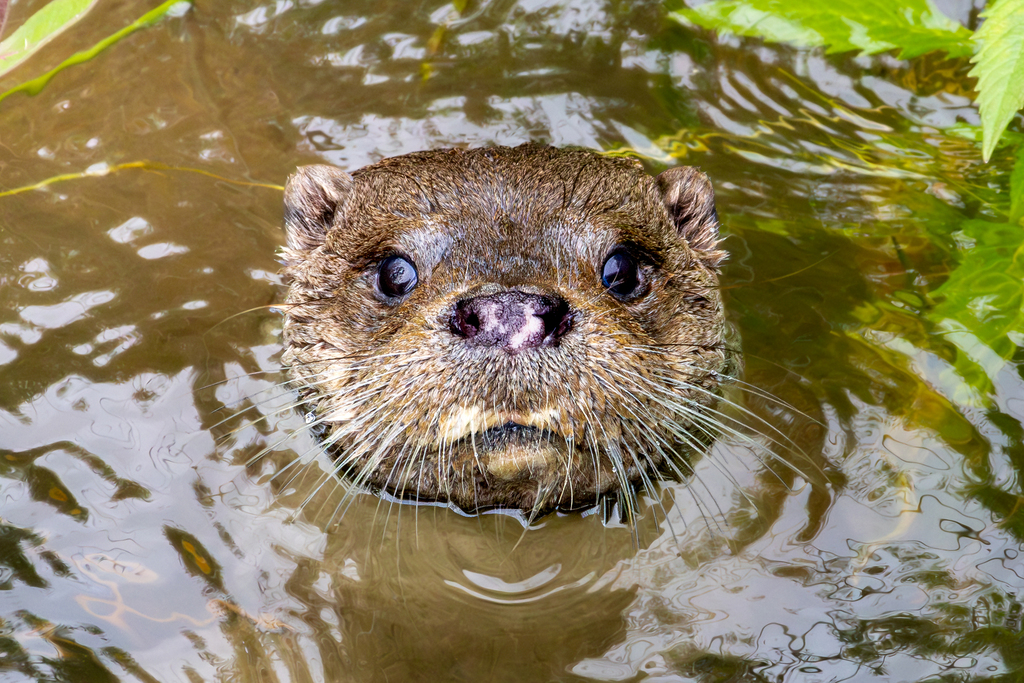
The common otter (Lutra lutra) is a streamlined, semi-aquatic mammal found on rivers, lakes, and coastlines across Europe, Asia, and North Africa. It is a dedicated fish hunter, mostly active at dawn and dusk, and sits at the Epic tier in Kaught because despite its wide range, an actual field sighting is a genuinely unusual event.
Otters are present on rivers that look completely empty of them. They rest in holts for ten or twelve hours a day, hunt under water, move silently, and have no interest in displaying themselves. Finding one takes deliberate effort: the right stretch of river, the right time of day, and the patience to stay still long enough. This guide walks through exactly how.
How to identify a common otter
The silhouette in water is diagnostic. An otter rides very low, with most of the body beneath the surface and just the head above. When it dives, the back arches in a smooth roll and the long, thick tail follows last, in a distinctive submarine curve. No other animal on a European river does this.
Key field marks:
- Colour: rich brown on top, a paler creamy or buff throat and underside. Wet, it looks darker and slicker than dry.
- Head: broad, flat, and wide for a mammal of this size, with small rounded ears set low and wide, and prominent white whiskers.
- Tail: thick at the base, tapering gradually to a point. This is different from a mink's thinner, more uniform tail, the most common confusion species in the UK and Europe.
- Movement in water: smooth, powerful, and unhurried. On land, it moves in a loping gallop with the body arching and the tail held low.
The American mink (Neovison vison), an invasive species established across much of Europe, superficially resembles an otter at a glance but is significantly smaller (under 1 kg) and darker, usually almost black. If you see it and think "small otter," you are probably looking at a mink.
Where common otters live
The common otter ranges across virtually the entire Palearctic: from Ireland and Portugal in the west through Europe, the Middle East, India, and East Asia to Japan. In Africa it reaches Morocco and coastal West Africa.
Within that huge range, its specific requirements are consistent:
- Clean water with abundant fish. Otters disappeared from polluted rivers across much of Western Europe in the mid-20th century and have returned as water quality has improved.
- Dense bankside vegetation for cover: willow, alder, and reed beds are ideal. Open, manicured banks with no cover are less productive.
- Holting sites: undercut banks, tree root cavities, or boulder piles at or just above waterline. An otter territory may contain dozens of potential holts over a stretch of several kilometres.
- Minimal human disturbance, particularly at dawn and dusk.
In the UK, the best remaining otter populations are in Wales, Scotland, and south-west England. In Europe, the Shannon system in Ireland, the rivers of the Iberian Peninsula, and the Polish and Scandinavian river networks hold strong populations. Coastal otters, which commute between saltwater and freshwater to flush salt from their fur, are common in the Scottish islands and in Portugal.
The common kingfisher shares much of the same river habitat, and the two species can occasionally be seen on the same stretch.
What otters eat, and how they hunt
Fish is the foundation: eels, salmonids, perch, roach, and whatever is locally abundant. An adult otter needs 1 to 1.5 kg of food per day, which on a good eel river can mean catching six or eight eels per night. On harder stretches it may need to cover several kilometres.
Otters hunt by swimming fast after individual fish, not by ambush. Their eyes are adapted to see clearly underwater, and their whiskers (vibrissae) detect pressure waves from moving fish, allowing hunting in turbid or completely dark conditions. A short dive seldom lasts more than 30 seconds; the otter returns to the surface to eat small catches, often using a favourite flat rock as a dining table.
Supplementary prey includes frogs, crayfish, water voles, and occasionally small ducks or moorhens. In coastal habitats, crabs and butterfish are common prey.
Finding otter signs: the practical approach
The most reliable sign is the spraint: the otter's distinctive tarry dropping, deposited on prominent landmarks as a scent-mark. Fresh spraints are dark, often greenish-black, and have a famously distinctive smell, not unpleasant, often described as jasmine or cut hay with fishy undertones. They dry to a pale, papery mass containing fish bones and scales.
Where to look for spraints:
- The top surface of large midstream boulders or bridge supports (otters emerge here to mark after passing under bridges).
- The junction of two streams or where a tributary meets a main river.
- Prominent stones or logs at water's edge near a known holt.
Footprints confirm otters are present. The otter's hind foot leaves a five-toed, webbed print about 6 to 7 cm long in soft mud or sand at the water's edge. The five toes are splayed, with visible claw marks, and the webbing sometimes prints between them. The stride pattern on land is a bounding gallop with paired prints close together, then a gap.
Slide marks: otters use steep clay or mud banks as slides, and repeated use wears a smooth groove down to the water. Seeing a fresh slide is excellent evidence of regular use.
Best times and conditions for a sighting
Dawn is the single best window. An otter returning from its night hunt to a holt, or beginning a morning session, will move along the waterline in the first 30 to 60 minutes of daylight. Arrive before first light, position yourself on an elevated bank with the river visible, stay still, and watch the water downstream.
Dusk is the second-best window. In summer, the long twilight keeps fishing conditions active; in winter, otters often begin hunting in the last 30 minutes before dark.
Avoid high-water, fast-flow conditions after heavy rain. Otters still fish in these conditions but move further from the bank and are harder to see. A stable, clear river at moderate level after a dry spell is ideal.
Compare this to the nocturnal animals guide, where similar dusk-and-dawn timing tips apply for hedgehogs and foxes, two other crepuscular species that reward patience at the right hour.
How rare is the common otter?
In Kaught, the common otter sits at the Epic tier: three diamonds out of four. Kaught's rarity reflects how often a species is actually recorded in the wild, not its population status. Otters are present on many European rivers but routinely unseen by people walking the same banks day after day. They are in the water; they are usually just not visible during the hours most people are there.
This is not the same as saying they are scarce. An Epic rating is the catalog's signal: "this species exists in your area, but a genuine sighting requires deliberate effort." It places the otter alongside the tawny owl and the red squirrel in the catalog's "definitely present, harder to catch than you think" tier.
Three things you probably did not know about the otter
- An otter's fur is so dense that the skin underneath never gets wet. The guard hairs trap air against an undercoat of roughly 70,000 hairs per square centimetre, creating an insulating layer that stays dry through a full dive.
- Otters do not have a fixed mating season. Cubs are born in any month of the year. This is unusual among British and European carnivores and means a family group can appear on a river in February or August.
- The spraint smell that humans find pleasantly jasmine-like is, to another otter, a detailed information pack: the sex, reproductive status, and identity of the marker, read through a chemical signature as precise as a fingerprint.
Common otter: frequently asked questions
What does a common otter look like?
A streamlined mammal about 90 to 130 cm long, weighing 5 to 12 kg, with a rich brown coat, pale cream throat, a broad flat head with small ears, prominent whiskers, and a thick tapering tail. In water, it rides very low and dives in a distinctive arching roll.
Where do common otters live?
Across Europe, Asia, and North Africa, wherever clean rivers, lakes, or coastal waters hold enough fish. It prefers undisturbed rivers with dense waterside vegetation and good bankside cover for holting.
What do otters eat?
Fish is the main diet year-round: eels, salmonids, perch, and whatever is locally abundant. An adult otter needs about 1 to 1.5 kg daily. Supplementary prey includes frogs, crayfish, water voles, and in coastal habitats, crabs and butterfish.
What is an otter holt?
An otter's den: a burrow in a riverbank, the root cavity of a large tree, or a space under boulders. Holts are usually accessed from underwater. A single otter may use several holts across its territory.
What is an otter spraint?
An otter dropping used as a territorial scent-mark. Spraints are dark, tarry, and have a distinctive jasmine-and-fish smell. They are deposited on prominent rocks, logs, or bridge bases. Finding a fresh spraint is the most reliable sign that an otter is actively using a stretch of water.
What time of day do otters come out?
Most active in the two hours around dawn and around dusk, and frequently through the night. Dawn is the single best window. They do occasionally fish in daylight in undisturbed locations.
Why is the common otter Epic in Kaught?
Kaught's Epic tier reflects how rarely a species is observed in the wild. Otters are present on many European rivers but are largely nocturnal and crepuscular, rest in holts for most of the day, and move quietly. Despite a wide range, genuine sightings require patience and good timing.
How do you find otters?
Look for spraints on prominent midstream rocks or at bridge bases, slide marks down steep clay banks, and five-toed webbed footprints in soft mud. Dawn visits to known otter rivers, staying still and watching from an elevated bank, give the best chance of a visual sighting.
The next thing you see could be
your first catch.
Kaught is live on the App Store and Google Play. Free to start, and your first catch is one photo away.
Free to start · Live on the App Store and Google Play
Species data, type, rarity tier and measurements, is drawn from the Kaught catalog, built on open biodiversity records from GBIF and iNaturalist. Rarity reflects how often a species is observed in the wild, not its conservation status.