
Exotic spotlight
Lace Monitor: the 2-metre climbing lizard that is the apex predator of the Australian bush
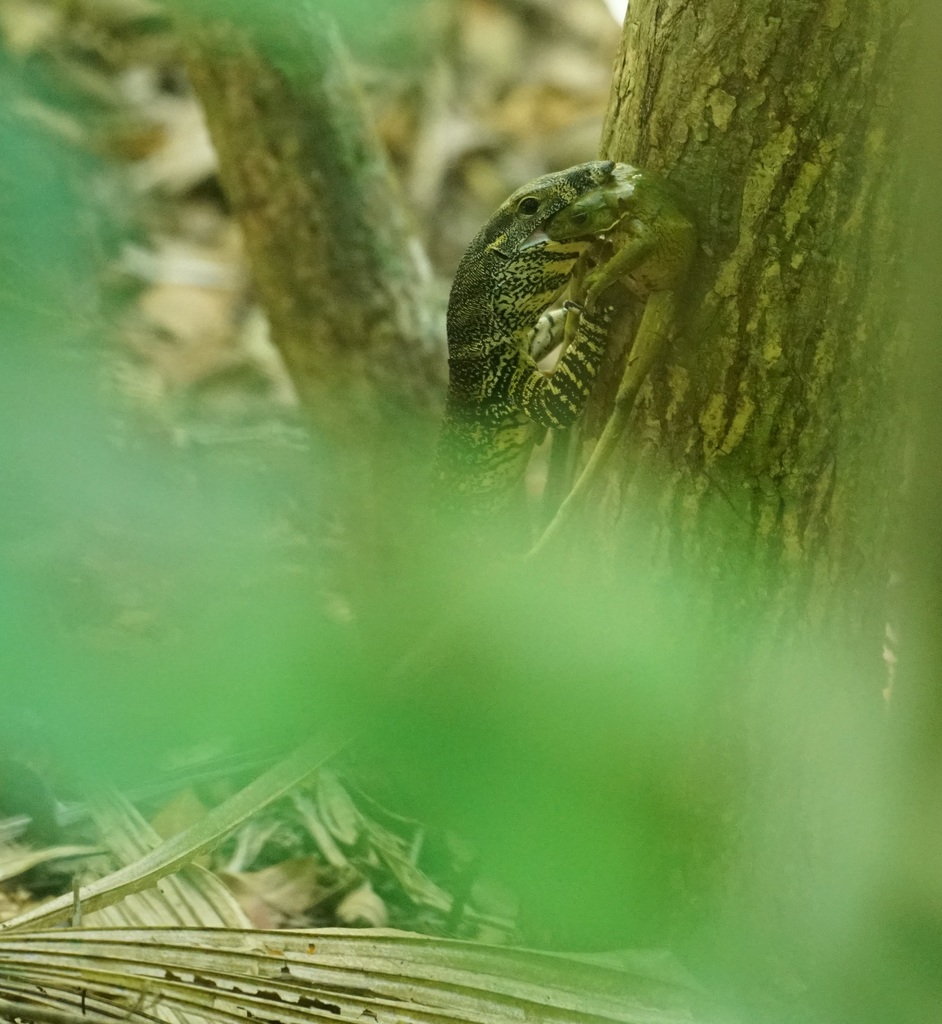
The lace monitor (Varanus varius) is Australia's second-largest lizard, reaching 2 m and 14 kg. It has a cream-and-black banded body, a forked tongue it flicks constantly to taste the air, and the ability to climb vertical tree trunks using curved claws. It eats almost anything it can catch or scavenge, and it will raid your campsite. Epic tier in the Kaught catalog.
Most Australians who have spent time in the bush have a lace monitor story. It might be the 1.5-metre lizard that walked through the picnic area and helped itself to a sausage. Or the large dark shape that spiralled up a eucalyptus trunk and froze, invisible against the bark, twenty seconds after you spotted it. This is a lizard that is both easy to stumble across and very easy to underestimate.
How to identify a lace monitor
The combination of size and pattern makes identification straightforward:
- Size: adults are immediately large, 1.5 to 2 m from nose to tail tip, with a body thicker than a person's forearm. Juveniles are smaller and more vividly patterned.
- Colour: the base colour is dark grey to black with cream or yellow spots and bands arranged in an irregular lace-like pattern, which gives the species its common name. This pattern is distinctive; no other large Australian lizard looks quite like it.
- Head: long and flattened with a pointed snout. The forked tongue is pale yellow and flickered out constantly, tasting the air for chemical signals.
- Legs: muscular, with long, curved claws that can grip bark as effectively as a set of crampon spikes.
- Tail: long and round in cross-section, used as a balance aid when climbing and occasionally as a defensive whip.
There is a banded form (previously called Varanus varius banding) and an unbanded form; both are now considered the same species. The banded form tends to be more strongly patterned.
Where lace monitors live
Eastern and southeastern Australia, from the rainforests of Cape York Peninsula south through New South Wales and Victoria into the southeastern corner of South Australia. They are essentially absent from the arid interior. Within their range they are catholic in habitat choice: coastal heath, open eucalyptus woodland, rainforest edge, river margins and increasingly, the fringes of suburban areas where national parks border housing.
They are fundamentally terrestrial foragers that climb readily, in contrast to strictly arboreal or aquatic varanids. A lace monitor moves between the ground, where it hunts and basks, and the trees, where it escapes, nests and sometimes sleeps.
The tongue and what it tells the lizard
Like the common water monitor of Southeast Asia, the lace monitor uses a forked tongue and a Jacobson's organ in the roof of its mouth to detect chemical signals in the air with exceptional sensitivity. The two tines of the forked tongue pick up scent molecules from two slightly different points in space, and the brain compares the inputs to triangulate the direction of a smell source, much like stereo hearing allows direction of a sound.
This is how a lace monitor finds carrion from hundreds of metres away. A dead kangaroo or wombat can attract multiple lace monitors within hours of death. At a carcass, they feed alongside each other with less aggression than you might expect, though a very large individual will assert priority over the best pieces.
What lace monitors eat
Everything. This is one of the least fussy large predators in Australia:
- Carrion: the primary food for large adults. Any vertebrate carcass, fresh or well-aged, is fair game.
- Small mammals: rabbits, bandicoots, young possums. A large lace monitor can kill a rabbit with a single bite.
- Birds and eggs: nest raids are common, the lizard climbing directly to active nests in trees. Bird eggs are swallowed whole.
- Reptiles and frogs: including other varanid species and blue-tongue lizards smaller than themselves.
- Insects and invertebrates: especially important for juveniles before they reach a size that allows larger prey.
The lace monitor's powerful jaw and recurved teeth allow it to consume bones as well as flesh. Unlike venomous predators that inject toxin, it relies on jaw strength and prey dismemberment.
Climbing: a serious advantage
The lace monitor's climbing ability is its most notable physical trait among Australian varanids. When threatened on the ground by a dingo or a large dog, a lace monitor typically bolts for the nearest large tree and spirals vertically up the trunk at speed, using claws that can pierce bark deeply enough to support its full weight. At height, it freezes, relying on its patterned camouflage to blend against the bark.
A juvenile lace monitor takes cover in the canopy very quickly after hatching and spends much of its early life in trees, where it is less vulnerable to terrestrial predators. Adults use the trees more selectively, climbing to escape threats, raid nests or bask.
The termite mound nursery
One of the more unusual breeding strategies among large reptiles. The female lace monitor locates a large, active termite mound and excavates a chamber in the wall, lays 6 to 12 eggs inside, then covers the entrance. The termites seal the breach themselves within days. Inside the mound, the eggs incubate in a perfectly stable, humidity-controlled environment that the termite colony maintains for its own purposes at precisely the temperature the lizard eggs require.
When the eggs hatch, after roughly 8 months, the female sometimes returns to dig out the hatchlings, though in other cases they find their own exit. It is unclear how the female locates the mound again after months away, but chemical marking is the likely mechanism. This strategy has also been documented in the Nile crocodile, which uses rotting vegetation mounds for similar temperature-stability reasons.
The lace monitor in the Kaught catalog
The lace monitor sits at the Epic tier in Kaught, three diamonds. This reflects the actual observation record: lace monitors are widespread in eastern Australia but difficult to spot in dense bush, and most people who walk through their habitat never see one unless they know where to look. National park picnic areas where lace monitors have lost their fear of people are the easiest places for a genuine encounter.
The Apex secondary type reflects the lizard's role as a top-order predator in its ecosystem, one that sits above almost every other terrestrial species in its size class.
Lace monitor: frequently asked questions
How big does a lace monitor get?
Up to 2 m in total length and 14 kg. Australia's second-largest lizard after the perentie. Females are consistently smaller. Despite the size, lace monitors are fast and agile both on the ground and in the canopy.
Where does the lace monitor live?
Eastern and southeastern Australia, from Cape York south through New South Wales and Victoria. It lives in coastal and inland woodland, open forest and national park bush wherever large trees and prey are available. It avoids true desert.
What does a lace monitor eat?
Carrion, small mammals, birds, eggs, reptiles, frogs and insects. Adults are powerful enough to kill adult rabbits. Carrion is a major food source and lace monitors can locate a carcass from hundreds of metres away using their chemical-sensing forked tongue.
Are lace monitors dangerous to people?
A cornered large individual can inflict serious lacerations with its claws and a painful bite. Campground animals that associate people with food can become bold and pushy. Give them space and never feed them. Problems almost always follow feeding.
Why does a lace monitor climb trees?
To escape terrestrial predators, to raid bird nests for eggs and chicks, to thermoregulate on exposed branches, and to rest. Juveniles spend much of their early lives in the canopy, where they are less vulnerable to dingoes and large snakes.
Why is the lace monitor Epic in Kaught?
Kaught rarity reflects how often a species is recorded in the wild. Lace monitors are widespread in eastern Australia but easily overlooked in dense bush. Epic, three diamonds, reflects the genuine effort required to reliably observe one in natural habitat rather than at a habituated picnic site.
How is the lace monitor different from a common water monitor?
The lace monitor is an Australian species with a cream-and-black banding pattern; the water monitor is an Asian species found near rivers from Sri Lanka to the Philippines. Both are large varanids with forked tongues, but the lace monitor is a stronger tree climber while the water monitor is more aquatic.
The next thing you see could be
your first catch.
Kaught is live on the App Store and Google Play. Free to start, and your first catch is one photo away.
Free to start · Live on the App Store and Google Play
Species data, type, rarity tier and measurements, is drawn from the Kaught catalog, built on open biodiversity records from GBIF and iNaturalist. Rarity reflects how often a species is observed in the wild, not its conservation status.