
Superlative ranking
Slowest animals in the world: 6 record-holders ranked
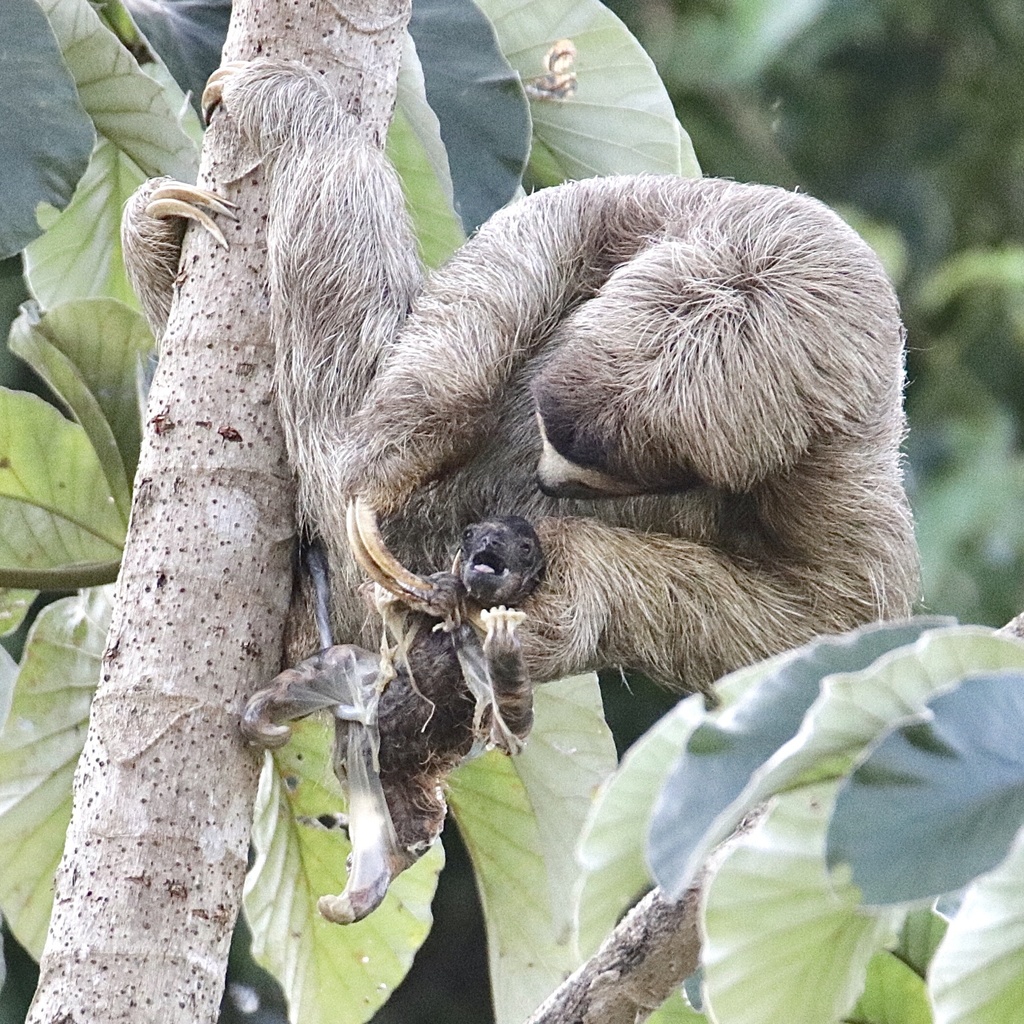
The three-toed sloth is the world's slowest mammal at 0.03 mph on the ground. The seahorse is the slowest fish at 1.5 m per hour. Both strategies work not despite the slowness but because of it: camouflage, low energy costs and a diet that does not require a fast pursuit.
Being fast costs energy. Being slow costs exposure. Every animal in this ranking has found a way to make that bargain work in its favour, through armour, toxins, camouflage or simply living where fast predators don't go. Here are six species, each with a verified record, ranked slowest to relatively less slow.
1. Three-toed Sloth: 0.03 mph on the ground
On the ground, a three-toed sloth moves at roughly 0.03 mph (about 0.048 km/h). Through the canopy, it manages up to 0.15 mph. In 24 hours of non-stop travel it would cover perhaps half a kilometre; in practice it stays almost motionless for 15 to 20 hours of every day.
This is not laziness. The sloth eats leaves from a small selection of trees, leaves that are tough, toxic and provide almost no available energy per gram. The sloth's metabolic rate is the lowest of any non-hibernating mammal. Moving slowly is not a side effect of this metabolism; it is the point. A motionless sloth in the canopy looks exactly like a knot of dead leaves. Green algae colonises its fur and improves the camouflage further. Howler monkeys that call from the canopy are loudly announcing their position to every harpy eagle in the forest; the sloth's silence is its defence.
One behavioural quirk stands out: sloths descend to the ground once a week to defecate. Why they don't simply drop waste from the canopy, as other arboreal animals do, is still debated. The leading theory is that the effort involved in the descent signals something useful to other sloths, though no clear consensus has formed.
2. Garden Snail: up to 0.03 mph
The garden snail moves by rippling muscular contractions along its single muscular foot on a continuously secreted mucus trail. The maximum recorded speed is around 0.03 mph under ideal conditions; typical movement is slower. In a race with the three-toed sloth, the snail might win on a flat surface.
The mucus is remarkable engineering. It functions simultaneously as a lubricant (reducing friction against the ground), an adhesive (allowing the snail to travel upside-down without falling), and a structural support (the snail essentially surfs on a self-generated road surface). The same material is under active investigation as a surgical adhesive because of how well it bonds to wet tissue.
Snails don't need speed. Their shell provides genuine protection against many predators, and mucus deters others. The ones that kill snails routinely, thrushes, for instance, solve the shell problem by smashing it against a rock.
3. Short-snouted Seahorse: 1.5 m per hour
The Guinness World Record for slowest fish goes to the dwarf seahorse at 1.5 m per hour; the short-snouted seahorse is comparable. A seahorse propels itself upright using only a tiny transparent dorsal fin, which beats approximately 35 times per second. Every beat drives the animal a fraction of a millimetre forward. The pectoral fins steer; everything else is postural.
The seahorse's survival strategy is to be invisible. It grips seagrass with its prehensile tail and stays still until prey, tiny crustaceans and larvae, drifts close enough to inhale. The snout is a vacuum pump: the seahorse flicks its head and snaps its mouth open with enough force to draw prey from a centimetre away with the suction. This requires zero speed. The slowness is the hunting strategy.
One other detail worth knowing: the male seahorse is pregnant. The female deposits eggs into a brood pouch on the male's abdomen, where he fertilises and gestates them, sometimes 100 to 200 young at once, and gives birth after a gestation of two to four weeks. It is one of the very few animals where the male goes through the full physical burden of pregnancy. See also our article on the giant seahorse for more on this unusual biology.
4. West Indian Manatee: 8 km/h cruising, occasional burst to 25 km/h
The manatee is not technically the slowest animal, but it is one of the slowest large mammals and a natural entry in any list about leisurely locomotion. Cruising speed is around 8 km/h; a burst to 25 km/h is possible but rarely sustained. It spends its days grazing on seagrass, surfacing to breathe every three to five minutes, and drifting slowly between patches.
The manatee's closest living relatives are not whales but elephants and hyraxes. That relationship shows in its flat nails, its continuously-replaced molars (a feature shared with elephants but vanishingly rare in other mammals) and its brain structure. It entered the water independently of cetaceans, from a common ancestor of Proboscidea, an evolutionary detour that happened roughly 50 million years ago.
Speed is irrelevant to a manatee. It has no natural predators in most of its range. The animals that kill manatees are boats: propeller strikes leave characteristic parallel scars on the back of many Florida individuals, scars so consistent that researchers use them to identify individual animals over years.
5. Koala: 150 to 200 m per day typical travel
The koala sleeps 18 to 22 hours a day. When it does move, it does so slowly and deliberately. Typical daily travel is 150 to 200 m, though a koala can run and swim when forced to, and has been tracked covering distances of several kilometres between tree patches.
The driver is the same as for the sloth: a genuinely terrible diet. Eucalyptus leaves are fibrous, low-calorie and loaded with phenolic compounds and terpenes that most animals cannot detoxify. The koala can, but the process requires a long, specialised digestive tract and a liver working overtime. The energy budget after detoxification and digestion barely exceeds maintenance costs, so the koala does the sensible thing: it sits in a tree and conserves every kilojoule.
A side effect of this is a very small brain. The koala has one of the lowest brain-to-body-mass ratios of any mammal; the cerebral cortex is so smooth that it sits free inside the skull rather than fitting snugly against it. Whether this is a consequence of the low-energy lifestyle or an ancestral feature is still discussed.
6. Gila Monster: up to 2.4 km/h, active only months per year
The Gila monster spends up to 98% of its life underground, emerging only during the cooler months to feed and store fat in its thick, sausage-like tail. When it does move, it lumbers at a maximum of about 2.4 km/h, which looks fast after the seahorse but is among the slowest recorded speeds for any lizard of its size.
The Gila monster and the Mexican beaded lizard (Heloderma horridum) are the only venomous lizard species in North America. Unlike the stonefish or the rattlesnake, the Gila monster delivers venom not by fang injection but by chewing: grooved teeth channel venom from glands in the lower jaw into the wound while the lizard refuses to let go. The effect on humans is excruciating pain that can last for hours. Fatalities are extremely rare but documented.
A compound derived from the Gila monster's saliva, exendin-4, became the basis for exenatide, a diabetes drug that has been prescribed to millions of patients. The animal's biochemistry was more medically valuable than anyone predicted.
The rankings, summarised
| Rank | Animal | Speed | Kaught tier |
|---|---|---|---|
| 1 | Three-toed Sloth | 0.03 mph (ground) | Common ◆ |
| 2 | Garden Snail | 0.03 mph | Common ◆ |
| 3 | Seahorse | 1.5 m/hour | Common ◆ |
| 4 | West Indian Manatee | 8 km/h cruising | Common ◆ |
| 5 | Koala | 200 m/day typical | Common ◆ |
| 6 | Gila Monster | 2.4 km/h max | Common ◆ |
Compare this list against our fastest animals in the world ranking and the contrast is stark: the peregrine falcon stoops at 390 km/h while the sloth covers 0.048 km/h on the ground. Both strategies have persisted for millions of years. Neither is more correct; both are answers to the same question: how do you stay alive long enough to reproduce?
Slowest animals: frequently asked questions
What is the slowest animal in the world?
The three-toed sloth is the slowest mammal at about 0.03 mph on the ground. The seahorse holds the record as the slowest fish at 1.5 m per hour cruising speed. Both survive not because of their speed but despite it: camouflage, low metabolic cost and specialised diets make speed unnecessary.
How slow is a sloth?
A three-toed sloth moves at roughly 0.03 mph on the ground and up to 0.15 mph in the canopy. Over 24 hours of non-stop travel it would cover about half a kilometre. In practice it stays almost motionless for 15 to 20 hours of every day.
Why are sloths so slow?
Sloths eat leaves that are toxic, hard to digest and nutritionally poor, so their metabolic rate is the lowest of any non-hibernating mammal. Moving slowly conserves the little energy they extract and, crucially, means a motionless sloth in the canopy looks like part of the tree to predators.
What is the slowest fish?
The seahorse. The dwarf seahorse is the confirmed record holder at 1.5 m per hour. It moves using only a tiny dorsal fin beating 35 times per second, anchors itself to seagrass and waits for prey to drift within range rather than pursuing it.
Are slow animals in danger from predators?
Slow animals rely on other defences: camouflage (sloth, seahorse), armour and venom (Gila monster), sheer size and aquatic habitat (manatee), or simply living in places where predators rarely venture. Speed is one survival strategy among many.
Is the koala the slowest marsupial?
The koala is among the slowest marsupials, covering just 150 to 200 m per day on average and sleeping 18 to 22 hours out of every 24. The diet of eucalyptus leaves provides so little net energy after detoxification that near-constant rest is metabolically necessary.
The next thing you see could be
your first catch.
Kaught is live on the App Store and Google Play. Free to start, and your first catch is one photo away.
Free to start · Live on the App Store and Google Play
Species data, type, rarity tier and measurements, is drawn from the Kaught catalog, built on open biodiversity records from GBIF and iNaturalist. Rarity reflects how often a species is observed in the wild, not its conservation status.