Exotic spotlight
Bumphead Parrotfish: the reef giant that headbutts coral and makes tropical beaches
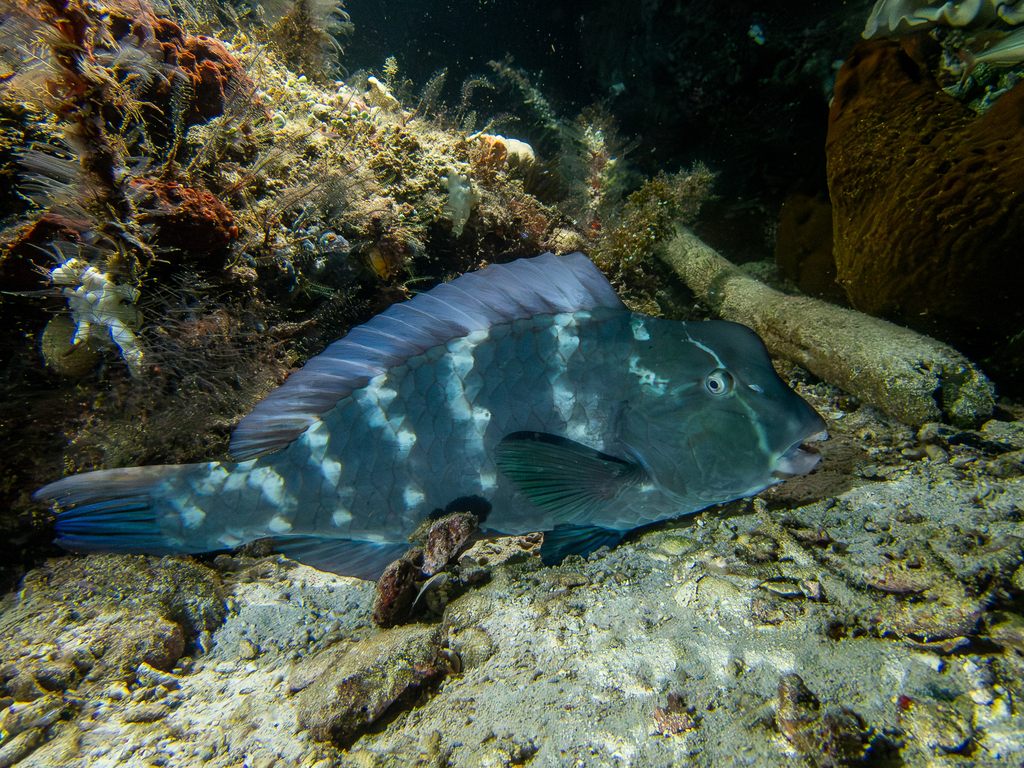
The bumphead parrotfish (Bolbometopon muricatum) is the world's largest parrotfish: up to 1.3 m, 46 kg, and travelling in schools of 75 on tropical Indo-Pacific reefs. Its bony forehead hump is a battering ram for live coral, which it grinds and excretes as white sand.
Most reef fish feed on what the reef offers without altering it. The bumphead parrotfish takes a different approach: it eats the reef itself. Each morning, schools of up to 75 fish move across the outer reef in a loose formation, pause at large coral heads, and ram them headfirst. The impact is audible underwater from 20 metres away.
What does a bumphead parrotfish look like?
The body is a blend of green, blue and pink scales that brightens with age. Adults are unmistakable for three reasons:
- The hump: a bulging, bony forehead that rises steeply from the snout. Older males develop the largest humps.
- The beak: fused teeth form a hard, parrot-like plate of pale blue or pink that can crack solid coral skeleton.
- The size: at up to 1.3 m, it dwarfs every other parrotfish on the reef. A large school moving across the sand looks like a slow-moving wall of green.
Juveniles are dark brown with white spots, almost unrecognisable as the same species. The adult colour develops gradually over several years.
How does it headbutt coral?
The bumphead parrotfish targets massive coral heads: the dense, boulder-shaped colonies of genera such as Porites that grow slowly over centuries. It swims back from the coral, accelerates, and strikes the surface with its forehead hump. The impact breaks off a mouthful of live coral, which it grinds with its beak. The fish digests the algae, coral polyps and organic matter inside, then excretes the ground coral skeleton as pure white sand.
A school of 50 bumphead parrotfish can consume and excrete more than a tonne of coral sand per year. Much of the fine white sand on tropical beaches and reef flats across the Indo-Pacific has passed through the gut of a parrotfish. The bumphead parrotfish is the largest contributor to this process of any single species.
The headbutting behaviour is communal. Fish in the school often strike the same coral head in succession, breaking off successively larger pieces. This differs from the scraping behaviour of smaller parrotfish, which graze algae off the surface without removing the skeleton.
Where do bumphead parrotfish live?
The bumphead parrotfish is restricted to healthy outer-reef habitats across the tropical Indo-Pacific: the Red Sea, East Africa, the Maldives, Sri Lanka, Indonesia, the Philippines, the Great Barrier Reef and the Pacific Islands as far east as Micronesia and Fiji. It cannot tolerate degraded or sedimented reef.
Schools sleep communally in sheltered caves and overhangs at night and move onto the outer reef at dawn. The best chance of a sighting is to be on a reef pass or outer slope at first light, when the school moves in from deep water. In coral reef habitats where the bumphead is still present, this dawn procession is one of the most spectacular events in the ocean.
Famous sites include Palau's Blue Corner, Tubbataha Reef in the Philippines, the Maldivian atolls and parts of the Great Barrier Reef. Schools are absent from most reefs; finding one requires seeking out the healthiest, most remote systems.
Is it dangerous?
No. Bumphead parrotfish ignore divers and snorkellers entirely. Their beak is a tool for coral, not for defence. The only genuine hazard is standing in the path of a moving school at dawn when the fish are not changing course for anything. They weigh up to 46 kg and do not stop.
Ciguatera fish poisoning has been recorded in humans who ate bumphead parrotfish in some Pacific regions: the toxin, produced by dinoflagellates on the reef, accumulates in large reef predators and grazers. The fish itself is not venomous. Local advice on consumption safety is worth checking in areas where ciguatera is known.
How rare is it in Kaught?
The bumphead parrotfish sits at the Epic tier in the Kaught catalog, three diamonds out of four. Kaught's rarity reflects observation frequency in the wild, not conservation concern. The bumphead is genuinely uncommon to encounter: it is absent from degraded reefs, restricted to specific outer-reef habitats, and the large schools that make it so spectacular are increasingly rare. A confirmed sighting earns three diamonds for good reason.
For context, the mantis shrimp sits at the same Epic tier, but for entirely different reasons: it hides in burrows and avoids detection. The bumphead is visible from above the surface, yet still hard to find precisely because its habitat requirements are so strict.
Three things about the bumphead you will not forget
- The forehead hump is solid bone. When schools are headbutting, the impacts create a sound like hollow tapping that carries clearly through the water.
- Fish within a school synchronise their sleep. They hover motionless together inside the same cave at night, emerging together at dawn in a coordinated procession.
- The bite force of the beak is sufficient to crack solid Porites coral, one of the hardest coral skeletons on the reef.
Bumphead parrotfish: frequently asked questions
What is a bumphead parrotfish?
The bumphead parrotfish (Bolbometopon muricatum) is the world's largest parrotfish, reaching 1.3 m and 46 kg. It lives on tropical Indo-Pacific coral reefs and travels in schools of up to 75 fish. The distinctive green hump above its eyes is used to ram live coral.
Why do bumphead parrotfish headbutt coral?
They ram coral heads to break off chunks of live coral, grind it with their fused beak-like teeth, digest the algae and polyps inside, then excrete the ground skeleton as fine white sand. A school can produce over a tonne of sand per year.
Where can you see bumphead parrotfish?
On healthy outer reef slopes and channel passes across the tropical Indo-Pacific, from the Red Sea to the Pacific. Best sites: Palau, Tubbataha Reef (Philippines), the Maldives, and the Great Barrier Reef. Most reliably seen at dawn when schools move onto the reef.
How rare is the bumphead parrotfish?
Epic tier in Kaught, three diamonds out of four. Kaught's rarity reflects observation frequency: the bumphead is absent from most reefs, restricted to healthy outer-reef habitats, and large schools are genuinely unusual encounters for most divers.
Are bumphead parrotfish dangerous?
No. They ignore divers. Their beak is a tool for coral. The only risk is standing in the path of a moving school at dawn. In some Pacific regions, eating them can cause ciguatera poisoning, so check local advice before consumption.
How big do bumphead parrotfish get?
Typically 1.0–1.3 m and 30–46 kg. Records report individuals up to 1.5 m and 75 kg, making them among the heaviest bony fish regularly found on coral reefs.
The next thing you see could be
your first catch.
Kaught launches soon. Join the waitlist and be first to start a collection of the living world, one photo at a time.
Free at launch · No spam, just one email on launch day
Species data, type, rarity tier and measurements, is drawn from the Kaught catalog, built on open biodiversity records from GBIF and iNaturalist. Rarity reflects how often a species is observed in the wild, not its conservation status.