
Legendary spotlight
Bog Turtle: Why North America's Smallest Turtle Is So Hard to Find
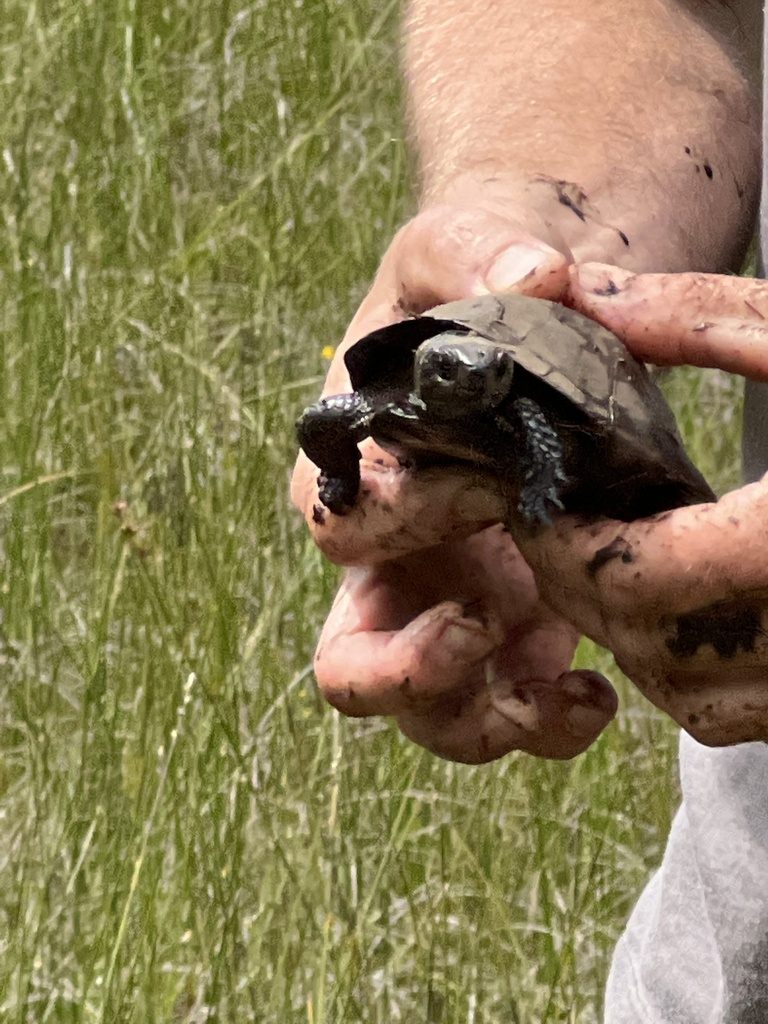
The bog turtle (Glyptemys muhlenbergii) is North America's smallest turtle, rarely topping 11 cm, and it spends most of the day buried in soft fen mud. An orange patch marks each side of its neck, but between its size, hidden habits and scattered colonies, a confirmed sighting is genuinely rare.
Most of the bog turtle's range sits within a short drive of a major East Coast city, in wetlands people walk past every day, and yet almost nobody who lives nearby has ever actually seen one. It is small enough to vanish into an inch of mud, active for only a few hours on a handful of spring mornings, and scattered across colonies that can number just a few dozen animals. In the Kaught catalog it sits at the Legendary tier, and once you understand how it actually spends its day, that rarity makes complete sense.
How to identify a bog turtle
It's small, dark and easy to miss, but a few marks are unmistakable once you catch sight of one:
- Size: a carapace length of roughly 7.5-11.4 cm at maturity, small enough to sit comfortably in a cupped hand. It is the smallest turtle species in North America.
- Shell: a dark brown to black carapace, often slightly domed, with faint tan or olive mottling across the individual scutes.
- The neck patch: a bright orange, yellow or amber blotch on each side of the neck, the single most reliable field mark, flashing briefly as the turtle lifts its head to look around.
- Underside: a yellowish-tan plastron, usually marked with irregular dark blotches.
Two other small turtles share its wetlands and get confused for it at a glance. The spotted turtle has scattered round yellow spots across a smoother black shell and no orange neck patch. The wood turtle is larger, with a rougher, pyramid-sculpted shell and an orange-tinged neck too, but it favours fast streams and woodland rather than soft fen mud, and it is noticeably bigger even as an adult.
Where do bog turtles live?
Bog turtles are wetland specialists in the narrowest sense: spring-fed fens, calcareous bogs and wet pastures with soft, saturated, mucky substrate, laced through with sunlit tussocks of sedge. They don't live in open water, ponds or lakes, and a dry meadow or a drained field is useless to them the moment it stops staying wet. A single turtle's home range is often just a hectare or two of this exact mix of mud, sedge and sun.
The species occurs in two disjunct population clusters roughly 400 km apart, with no turtles connecting them: a northern cluster running from New York and New Jersey through Pennsylvania, Maryland and Delaware into Virginia, and a separate southern cluster across Virginia, North Carolina, South Carolina, Georgia and Tennessee. Each cluster is itself a patchwork of small, isolated wetlands rather than one continuous range, and the narrow strip of habitat each colony depends on can disappear entirely if the spring feeding it is capped, or if the open sedge closes over with taller invasive plants and shades out the basking spots a turtle actually needs.
Why the bog turtle is one of the hardest turtles to actually spot
Three things stack against ever seeing one. First, it spends most of each day tunnelled into soft mud or burrowed under a mat of sedge and sphagnum moss, completely out of sight even to someone standing right over it. Second, it only reliably surfaces to bask or forage in short morning windows in spring, roughly April into June, before tall vegetation closes in overhead and before summer heat sends it back underground. Third, its colonies are naturally small and widely scattered, often just a few dozen turtles spread across a patch of wetland no bigger than a few football fields.
If you want a realistic shot, the window is a sunny morning in April or May. Scan the open, sun-exposed sedge tussocks and bare mud right at a fen's edge for a brief flash of orange at the neck, rather than watching open water, a bog turtle almost never basks out in the open the way a pond turtle does.
Is it legal to pick up or keep a bog turtle?
No. Handling, collecting or keeping a bog turtle without a specific state permit is illegal everywhere it occurs, and international trade in the species is tightly restricted. The combination of a tiny range and a tiny, easily recognised turtle has made it a long-standing target for illegal collectors, which is exactly why the legal protection is so strict. If you're lucky enough to find one in the wild, the only correct move is to admire it, take a photo, and leave it exactly where it was.
How rare is the bog turtle in the Kaught catalog?
At Legendary, four diamonds out of four, the bog turtle sits at the top of Kaught's rarity scale. That's worth a word of explanation, because it isn't a statement about conservation status. Kaught's rarity tracks how often a species is actually recorded in the wild, and almost nothing stacks the odds against a sighting quite like this turtle does: minuscule size, a mud-burrowing lifestyle, a handful of active weeks a year, and colonies measured in dozens rather than hundreds. Compare that to the blind mole rat, another Legendary-tier mammal that spends its entire life out of sight underground, or the changeable hawk-eagle, common across a huge range yet rarely confirmed because it hunts hidden in foliage.
Three things you didn't know about the bog turtle
- It's North America's smallest turtle. A full-grown adult is small enough to sit easily in one cupped hand.
- Its two population clusters, northern and southern, sit roughly 400 km apart with no turtles in between, likely split long ago as wetlands shifted with the climate.
- It occasionally hybridises in the wild with the spotted turtle, a genuinely rare cross between two different genera that researchers have confirmed with genetic testing.
For another wetland reptile that survives almost entirely out of sight, see the hellbender, a giant salamander that breathes through folded skin in cold mountain streams, or the desert monitor, a Legendary-tier lizard that vanishes into a burrow at the first sign of a footstep.
Bog turtle: frequently asked questions
What does a bog turtle look like?
A small, dark brown to black turtle, usually no more than 11 cm long, the smallest turtle species in North America. The reliable field mark is a bright orange or yellow patch on each side of its neck, often visible only for a moment as it lifts its head.
Where do bog turtles live?
Spring-fed fens, bogs and wet pastures with soft, saturated mud and open sunny tussocks, never open water. Two disjunct clusters of the eastern United States: a northern group from New York to Maryland and Virginia, and a southern group from Virginia to Georgia.
Why are bog turtles so hard to spot?
They spend most of each day tunnelled into mud or under matted sedge, surfacing to bask or forage only in short morning windows in spring. Colonies are also small and scattered, so even inside good habitat the odds of a chance encounter are low.
Is it legal to pick up or keep a bog turtle?
No. Handling, collecting or keeping a bog turtle without a state permit is illegal everywhere it occurs, and international trade is tightly restricted. If you find one, admire it, photograph it, and leave it exactly where it was.
What do bog turtles eat?
They're omnivores, foraging in shallow mud and vegetation for insects, snails, seeds and berries, with the occasional bit of carrion. Most feeding happens during the same brief morning activity window as basking.
Why is the bog turtle "Legendary" in Kaught?
Kaught's rarity tier reflects how often a species is actually recorded in the wild, not whether it's endangered. Between its tiny size, mud-burrowing habit and small scattered colonies, a confirmed sighting is genuinely rare, which places it at the Legendary tier.
The next thing you see could be
your first catch.
Kaught is live on the App Store and Google Play. Free to start, and your first catch is one photo away.
Free to start · Live on the App Store and Google Play
Species data, type, rarity tier and measurements, is drawn from the Kaught catalog, built on open biodiversity records from GBIF and iNaturalist. Rarity reflects how often a species is observed in the wild, not its conservation status.