Superlative
Tallest animals in the world: 7 record-holders ranked by height
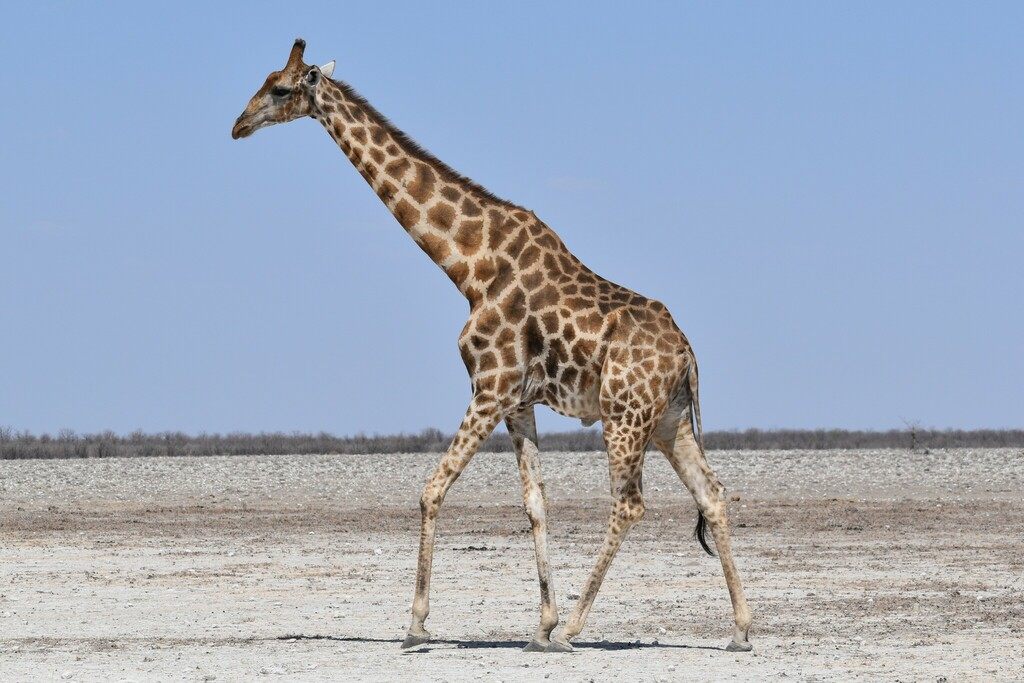
The southern giraffe is the tallest living animal at up to 5.8 m. Below it: the African elephant at 3.3 m at the shoulder, the brown bear at 3 m standing upright, the dromedary camel at 2.8 m, the ostrich at 2.8 m, the moose antler-tips at 2.7 m, and the emu at 1.9 m. Every entry is a Kaught catalog species.
Height in animals is rarely a straight comparison. Shoulder height, total standing height, height with antlers, height with a raised trunk: each measure tells a different story. This ranking uses the tallest reliable figure for each species under normal conditions, not special postures. All seven are in the Kaught catalog.
1. Southern Giraffe: up to 5.8 m
No living animal comes close. A large male southern giraffe stands 5.5 to 5.8 m from hoof to horn tip. The neck alone is around 2 m, supported by just seven vertebrae, the same number as every other mammal, each stretched to nearly 30 cm. The extra reach lets the giraffe browse the top metres of acacia canopy that no ground competitor can access.
The heart to match it: a giraffe's heart weighs around 12 kg and generates blood pressure roughly twice that of a human to push blood up to 2 m of neck. Specialised valves and a tight-skin "g-suit" on the legs prevent blood pooling when the animal drinks with its neck lowered, one of the more elegant engineering solutions in vertebrate anatomy.
Height in the Kaught catalog: Common tier, one diamond. Giraffes are observable across large parts of African savanna habitat and parks; a sighting is achievable rather than exceptional.
2. African Savanna Elephant: up to 3.3 m at shoulder
The largest land animal by mass, the African savanna elephant reaches 3.3 m at the shoulder in very large bulls. Add a raised trunk and the functional height for reaching food or threatening rivals exceeds 4 m, well above the shoulder figure. No other land animal can match this reach-to-body-mass combination.
This is an animal covered in depth in our heaviest ranking. The relevant height point: elephant bulls deliberately seek out tall, isolated trees to rub their foreheads on, a behaviour thought to produce cooling by pressing blood vessels against the bark, only possible for an animal with a head 2.5 m off the ground.
3. Brown Bear: up to 3 m standing
The brown bear is measured on all fours at around 1.5 m at the shoulder, but standing upright on its hind legs, large Kodiak and Kamchatka brown bears reach 3 m. This is not a typical posture for locomotion but it is a natural one: bears stand upright to look over vegetation, to scent-mark tree trunks and, very occasionally, to intimidate rivals and threats.
A standing bear at 3 m eye level is one of the most alarming encounters in nature. Its forelimb strike force is enough to kill an elk, delivered from that height. Kodiak Island bears are the largest subspecies, benefiting from rich salmon runs that sustain body masses of 400 to 600 kg.
4. Dromedary Camel: up to 2.8 m to hump
The dromedary stands 1.8 to 2.1 m at the shoulder, but the single hump extends this to roughly 2.4 to 2.8 m at the hump's apex. Neck fully extended during social display, the animal can raise its head over 3 m. The dromedary is the tallest fully domesticated animal species on Earth.
The hump contains fat, not water: up to 80 kg of it, metabolised as an energy reserve during long dry-season travel across the Sahara and Arabian Peninsula. Camels can lose up to 40% of their body water before showing signs of dehydration, then rehydrate at a rate of 200 litres in 15 minutes without ill effect. Oval-shaped red blood cells, unlike the round cells in most mammals, maintain flow through blood thickened by dehydration.
5. Common Ostrich: up to 2.8 m
The world's largest and heaviest bird. Male ostriches stand 2.1 to 2.8 m and weigh up to 156 kg. They are completely flightless, their wings reduced to display and balance organs, but they compensate with speed: a sustained 45 km/h and sprint bursts to 70 km/h make the ostrich the fastest running bird and faster than almost any terrestrial predator over distance.
The eyes are the largest of any land animal at 5 cm diameter, each bigger than the bird's own brain. Effective predator detection from height is the obvious advantage. The kick of a male ostrich, delivered downward with a single large claw, is capable of killing a lion.
6. Moose: up to 2.7 m to antler tips
The moose is the tallest deer species by a large margin, with large bulls standing 1.8 to 2.1 m at the shoulder. Add the palmate antlers, which can span 1.8 m across and add 60 cm of height, and the tip-to-hoof height of a standing bull reaches 2.5 to 2.7 m. The antlers are shed and regrown every year, one of the fastest sustained growth processes in any mammal: a moose antler grows at up to 2.5 cm per day during the summer velvet phase.
Moose are the only deer known to forage underwater, submerging to feed on aquatic plants from lakebeds and holding their breath for up to 50 seconds. Their long, pendulous snouts, the largest relative to skull size of any deer, are adapted to cropping submerged vegetation and clearing deep snow to reach buried browsing.
7. Emu: up to 1.9 m
Australia's largest native bird and the second-tallest bird in the world, the emu stands 1.5 to 1.9 m and runs at up to 50 km/h on three-toed feet. Like the ostrich, it is flightless: its wings have been reduced to tiny vestigial structures just 20 cm long, invisible under the droopy double-feathered plumage.
Males incubate the eggs and raise the chicks entirely alone for up to 18 months, fasting through much of the incubation period. The 1932 Emu War, in which the Australian military deployed machine guns against a flock of 20,000 emus causing agricultural damage in Western Australia, ended in effective defeat for the military: emus dispersed and regrouped faster than they could be culled, and the campaign was abandoned after several weeks. The emus won.
Tallest animals: frequently asked questions
What is the tallest animal in the world?
The southern giraffe (Giraffa giraffa) is the tallest living animal. Males reach 5.5 to 5.8 m in total height, with exceptional individuals confirmed at 5.87 m. The neck alone accounts for around 2 m of this height.
What is the tallest bird in the world?
The common ostrich (Struthio camelus), standing up to 2.8 m. It is also the world's largest and heaviest bird, with males weighing up to 156 kg. The emu is the second tallest at up to 1.9 m.
Is a brown bear taller than an elephant?
A brown bear standing on its hind legs reaches 3 m, compared with an African elephant's shoulder height of up to 3.3 m. The elephant at the shoulder is marginally taller on all fours, and its trunk raised takes it well over 4 m. The bear's standing posture is not sustained locomotion.
How tall is a moose?
Bull moose stand 1.8 to 2.1 m at the shoulder. Adding antlers, which can span 1.8 m across, the tip-to-hoof height reaches 2.5 to 2.7 m. The moose is the tallest deer species by a wide margin.
How tall is a dromedary camel?
Dromedaries stand up to 2.1 m at the shoulder and up to 2.8 m to the top of the hump. The neck extended takes the head over 3 m. It is the tallest fully domesticated animal on Earth.
What is the tallest flightless bird?
The common ostrich at up to 2.8 m. The emu is second at 1.9 m. Both are ratites: ancient flightless birds whose ancestors diverged from flying relatives more than 80 million years ago.
The next thing you see could be
your first catch.
Kaught launches soon. Join the waitlist and be first to start a collection of the living world, one photo at a time.
Free at launch · No spam, just one email on launch day
Species data, type, rarity tier and measurements, is drawn from the Kaught catalog, built on open biodiversity records from GBIF and iNaturalist. Rarity reflects how often a species is observed in the wild, not its conservation status.