
Legendary spotlight
The Sable: one of the hardest wild mammals to ever spot in Siberia
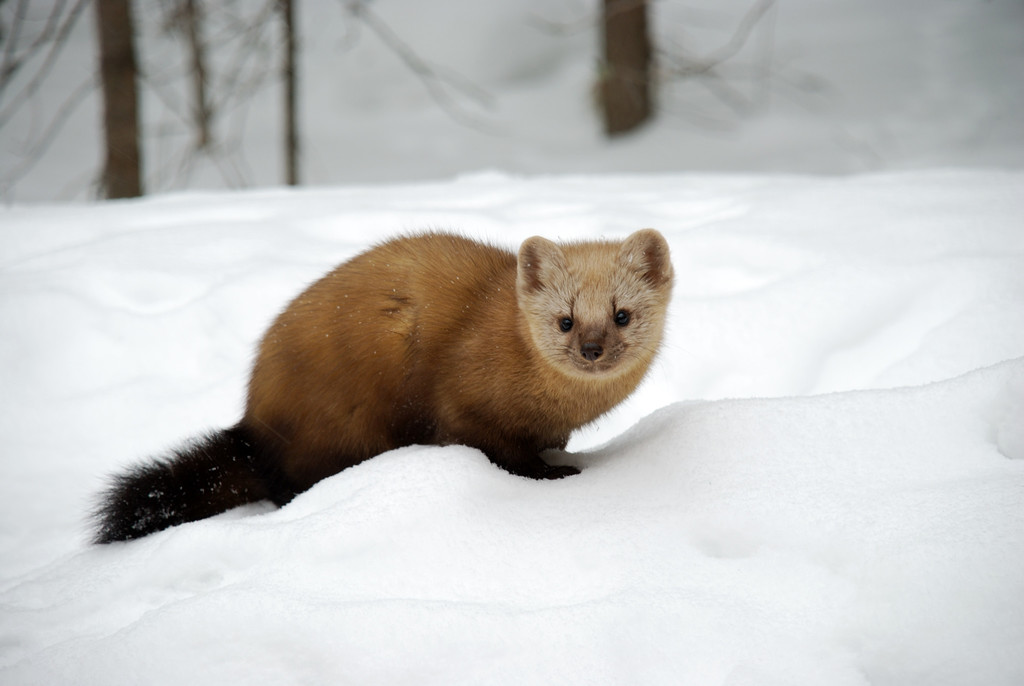
The sable (Martes zibellina) is a small, dark-furred mustelid of the Siberian taiga, closely related to the pine marten but remote, wary and extremely rarely observed. Legendary tier in Kaught, four diamonds. It hears prey moving under 30 cm of snow and was the most commercially prized fur animal in history.
If you know the pine marten, you have a rough idea of the sable's shape. The two animals are close relatives, both agile, dark-furred mustelids of northern forest. The difference is geography and scarcity. Where the pine marten occasionally shows itself at a bait station or forest edge in Western Europe, the sable inhabits a vast, cold, roadless belt of Siberian taiga where encounters with people are rare enough that most naturalists never see one in a lifetime of field work.
What does a sable look like?
A compact, low-slung carnivore, 38 to 56 cm long and weighing under 2 kg. The fur is famously dense and soft, typically dark brown to near-black, sometimes with a pale ochre or grey throat patch. The ears are large, rounded and somewhat cat-like, set wide on a broad, slightly flattened skull. The legs are short, the body elongated, typical of the mustelid body plan built for moving through tight spaces and under snow.
Colour varies geographically. Populations from the Barguzin Valley in Siberia tend to produce the darkest, most uniformly black individuals, which historically commanded the highest prices in the fur trade. Eastern populations toward Hokkaido can be lighter, more brown-toned.
Habitat: the old-growth taiga
The sable is a specialist of mature boreal forest, the taiga. It prefers old-growth stands with dense understorey, fallen timber in various stages of decay, rocky outcrops and streams. It does not do well in young, managed or fragmented forest. The Ural Mountains mark the western edge of its range, Hokkaido, Japan, the eastern limit. Between those endpoints lies one of the largest continuous boreal forest systems on Earth.
It dens in rock crevices, hollow logs, burrows under tree roots and occasionally in old squirrel dreys. A home range typically covers 4 to 30 square kilometres, varying by habitat quality and season, and is marked with scent from anal glands.
Hunting in winter: hearing through the snow
Winter is when the sable's sensory capabilities matter most. Small rodents: voles, shrews and lemmings, stay active under the snowpack in the subnivean space, moving through tunnels and eating stored plant material. To a sable above the snow, this produces almost no visible sign. But sound travels clearly through settled snow, and the sable's hearing is acute enough to detect the rustling and scraping of a vole moving under 30 cm of packed surface.
Once the prey is located, the sable plunge-dives, punching through the crust and driving its forepaws down to the prey level. The success rate in observed hunts is high. This subnivean hunting strategy is shared with the red fox and the short-eared owl, a good example of convergent behaviour: unrelated animals solving the same winter foraging problem the same way.
Outside of winter it also takes birds, squirrels, fish, insects, berries and carrion. It is an opportunist that adjusts its diet to what is abundant.
The animal that shaped Siberian history
No animal had a greater economic influence on the exploration and settlement of Siberia than the sable. From the 11th century onward, sable fur was among the most valuable commodities traded across Eurasia, prized above ermine and fox for its warmth, softness and glossy darkness. Russian expansion east across Siberia from the 16th century was driven almost entirely by fur tribute, and sable pelt collection was the primary economic engine of that expansion.
By the late 19th century, overtrapping had pushed the sable close to local extinction across much of its range. Recovery followed strict protection and regulated trapping quotas introduced in the Soviet era; populations today are substantially recovered. This history is not conservation status, it is context: the sable has been one of the most commercially significant wild mammals in the Northern Hemisphere for centuries.
How rare is a wild sable sighting?
In the Kaught catalog, the sable sits at Legendary tier, four diamonds. That number reflects confirmed observations in citizen-science records, and the count is very low. The reasons are straightforward: the sable lives in remote Siberian forest that sees limited naturalist foot traffic; it is largely crepuscular and moves at a pace that keeps it away from open areas; and centuries of being hunted have made it wary of people. Even dedicated mustelid researchers working in prime sable habitat describe most detections as tracks, scats or camera-trap images rather than direct sightings.
If you want to try: late winter in the Russian Far East or Hokkaido offers the best conditions. Snow reveals tracks. The classic sign is a bounding gait pattern, paired prints, landing wide, the mustelid lope pattern familiar from stoat and weasel but larger. Fresh tracks near streams or fallen logs in old-growth forest suggest an active animal. An encounter with the animal itself, standing alert on a log, ears forward, is among the rarer mammal sightings in the northern hemisphere.
The sable sits in the same Legendary tier as the Eurasian lynx, another northern forest specialist rarely seen in the wild. For more on the mustelid family, the pine marten guide covers the sable's closest European relative. For night-active mammals more broadly, see nocturnal animals you can spot after dark.
Sable: frequently asked questions
What is a sable animal?
The sable (Martes zibellina) is a small carnivorous mammal in the marten family, native to boreal forest across Russia and into northern Mongolia and Hokkaido, Japan. Dark-furred, compact and wary, it is among the rarest-observed mammals in citizen-science records.
Where does the sable live?
Old-growth boreal forest (taiga) across Siberia and the Russian Far East, from the Ural Mountains east to Hokkaido, Japan, and south into northern Mongolia. It prefers mature forest with fallen timber, rocky outcrops and streams.
What does a sable look like?
A compact, short-legged mustelid 38 to 56 cm long, weighing under 2 kg. The fur is dark brown to near-black with a pale throat patch. Large rounded ears, a broad skull and a short tail distinguish it from a weasel.
How does the sable hunt under snow?
It listens. The sable's hearing is acute enough to detect small rodents moving under 30 cm of packed snow. Once located, it plunge-dives through the surface to reach the prey, a technique shared with the red fox but adapted for deep Siberian snowpack.
Why is the sable Legendary in Kaught?
Kaught's rarity tier reflects observed sighting frequency, not conservation status. The sable inhabits remote Siberian taiga, is largely crepuscular and very wary. Confirmed wild sightings in citizen-science databases are vanishingly rare, placing it at Legendary: four diamonds.
Is the sable related to the pine marten?
Yes, closely. Both are species within the genus Martes: the pine marten (Martes martes) is the Western European equivalent, the sable (Martes zibellina) the Siberian one. The two have been known to hybridise where their ranges overlap in the Urals.
The next thing you see could be
your first catch.
Kaught is live on the App Store and Google Play. Free to start, and your first catch is one photo away.
Free to start · Live on the App Store and Google Play
Species data, type, rarity tier and measurements, is drawn from the Kaught catalog, built on open biodiversity records from GBIF and iNaturalist. Rarity reflects how often a species is observed in the wild, not its conservation status.