
Exotic spotlight
Australian Pineapplefish: the armoured fish that glows in the dark
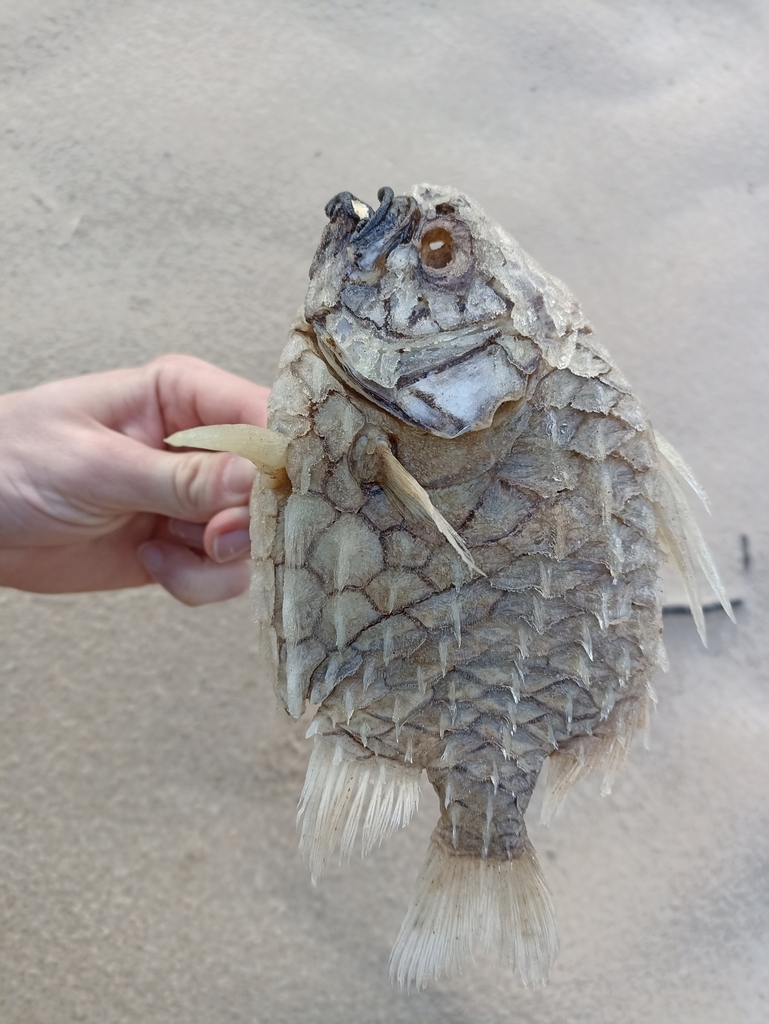
The Australian Pineapplefish (Cleidopus gloriamaris) is a small, nocturnal reef fish found only off Australia's coastlines. It is sheathed in rigid, interlocking bony plates, armed with locking spines, and carries colonies of bioluminescent bacteria near its jaw that glow blue-green in the darkness of the deep reef. A Legendary-tier species in the Kaught catalog and one of the most unusual fish in the Indo-Pacific.
There is a fish off the coast of Australia that looks like it was designed by someone who had never seen a fish, only a pineapple. Its body is sheathed in thick, interlocking plates of modified scales, yellow-orange with black outlines, that lock together into armour rigid enough to limit the fish's ability to flex its body at all. It has locking spines. It glows in the dark. And it belongs to one of the most observation-scarce species in the Kaught catalog.
What does the Australian Pineapplefish look like?
The silhouette is immediately distinctive: a laterally compressed, almost oval body up to 22 cm long, with a large head and an upturned mouth. The scales have been replaced, through evolution, by a series of rigid bony plates called scutes, each one interlocking with its neighbours. The colour is vivid: yellow-orange plates edged in black, giving the fish the tessellated look of a pineapple skin up close.
Three features stand out in the field:
- The bony armour. The plates are not decorative. They form a near-complete shell around the body, leaving only the fins and tail mobile. A predator attempting to swallow a pineapplefish encounters something closer to a rock than a fish.
- Locking spines. A robust, locking first dorsal spine and two prominent pelvic spines can be locked erect. When threatened, the fish wedges itself into a crevice with spines deployed, making extraction almost impossible.
- The glowing jaw. At the corner of each side of the lower jaw sits a small, translucent organ. In total darkness, these glow a dim blue-green. It is one of the few external bioluminescent organs found on the body of a fish, rather than inside it.
The biology of the glow: bacteria, not the fish
The pineapplefish does not produce its own light. The organs near its jaw are home to dense colonies of bioluminescent bacteria, specifically Photobacterium leiognathi, a species that generates light through a chemical reaction involving the enzyme luciferase.
The bacteria live in a mutually beneficial relationship with the fish. They get a stable environment and nutrients; the fish gets a pair of living light organs it did not have to evolve from scratch. The glow is always on: the pineapplefish cannot switch it off. Instead, it controls exposure by turning the organs toward or away from whatever it is approaching.
What does the fish use the light for? The leading hypothesis is prey attraction. At depths of 20 to 200 metres, where the pineapplefish lives, sunlight is negligible. Small crustaceans and zooplankton are attracted to any light source. The upturned mouth directly below the glowing jaw organs places the fish well to exploit this.
Where to find one
The pineapplefish is endemic to Australia: found along the eastern coastline from southern Queensland down to Victoria, and on parts of the western coast. It is a reef species, preferring rocky outcrops and sea caves at depths of roughly 20 to 200 metres. During the day it hides in crevices and under overhangs, often in groups of several individuals. At night it moves into open water above the reef to feed.
Despite living in Australian waters, it is not a common sight even for experienced divers. Most encounters happen at the deeper end of recreational diving range, in caves and overhangs that require specific conditions to penetrate safely. The Kaught catalog rates it at Legendary, four diamonds out of four, a reflection of how rarely it is actually recorded in open observation data.
How it relates to other armoured fish
The pineapplefish belongs to the family Monocentridae, a small family with only three or four recognised species worldwide. Its closest relatives include the Japanese Pineapplefish (Monocentris japonica), which also carries bioluminescent jaw organs but is smaller and more widely distributed across the Indo-Pacific.
The armoured body plan has evolved independently in many fish lineages. The Dragon Seamoth is another striking example: a similarly rare, heavily plated Indo-Pacific fish that walks the seafloor on modified fins. The two are not closely related; their armour is convergent evolution solving the same problem, being hard to eat, via the same method, getting a rigid outer shell.
The pineapplefish's bioluminescence also places it alongside species like the anglerfish and the Ribbon Eel in the category of animals that use light or startling biology to make a living in the deep. It is less mobile than either, but its defences are arguably more complete.
Three things that make this fish genuinely strange
- Its armour is so rigid that the pineapplefish cannot bend its body the way most fish do. It swims almost entirely by beating its pectoral and tail fins, a slow, hovering style that makes it look more like a powered balloon than a fish.
- The bioluminescent bacteria in its jaw organs are the same genus used by other species across the Indo-Pacific, including some squids. Researchers have found the same bacterial strains in distantly related light-organ-bearing species, suggesting horizontal transfer through the shared ocean environment.
- Juvenile pineapplefish apparently lack the developed bioluminescent organs. The bacteria colonise the jaw organs as the fish matures, meaning young individuals have armour but no glow.
Australian Pineapplefish: frequently asked questions
What is the Australian Pineapplefish?
A small, nocturnal reef fish found only in Australian waters. It is armoured in interlocking bony plates, armed with locking spines, and carries colonies of bioluminescent bacteria near its jaw that glow blue-green in the deep. It belongs to the family Monocentridae and reaches about 22 cm.
Why does the Australian Pineapplefish glow?
The glow comes from bioluminescent bacteria (Photobacterium leiognathi) living in two organs at the corners of its lower jaw. The fish does not make its own light. The permanent glow may attract small crustaceans toward the fish's upturned mouth in the darkness of the deep reef.
Where does the Australian Pineapplefish live?
Rocky reefs and sea caves off eastern and western Australia, at depths of 20 to 200 metres. It hides in crevices by day and hunts in open water at night. It is found nowhere else in the world.
Is the Australian Pineapplefish rare?
In the Kaught catalog it is Legendary, four diamonds out of four. That reflects how rarely it is observed in the wild: deep habitat, nocturnal habits, and a range restricted to Australian waters add up to very few recorded sightings.
What does the Australian Pineapplefish eat?
Small crustaceans and zooplankton near the seafloor, hunted nocturnally. Its upturned mouth and position of the jaw-light organs suggest it may lure prey from below, ambushing whatever the glow attracts.
How does the pineapplefish protect itself?
Its interlocking bony plates form near-complete armour. Locking dorsal and pelvic spines can be deployed and wedged into a crevice, making the fish almost impossible to extract or swallow.
Is it related to the Dragon Seamoth?
Both are heavily armoured Indo-Pacific fish, but they belong to different orders. Their armour evolved independently, a case of convergent evolution. The pineapplefish (Beryciformes) and the Dragon Seamoth (Syngnathiformes) are not closely related.
The next thing you see could be
your first catch.
Kaught is live on the App Store and Google Play. Free to start, and your first catch is one photo away.
Free to start · Live on the App Store and Google Play
Species data, type, rarity tier and measurements, is drawn from the Kaught catalog, built on open biodiversity records from GBIF and iNaturalist. Rarity reflects how often a species is observed in the wild, not its conservation status.