
Adaptation explainer
Do Pikas Hibernate? Why They Spend Winter Awake Under the Snow
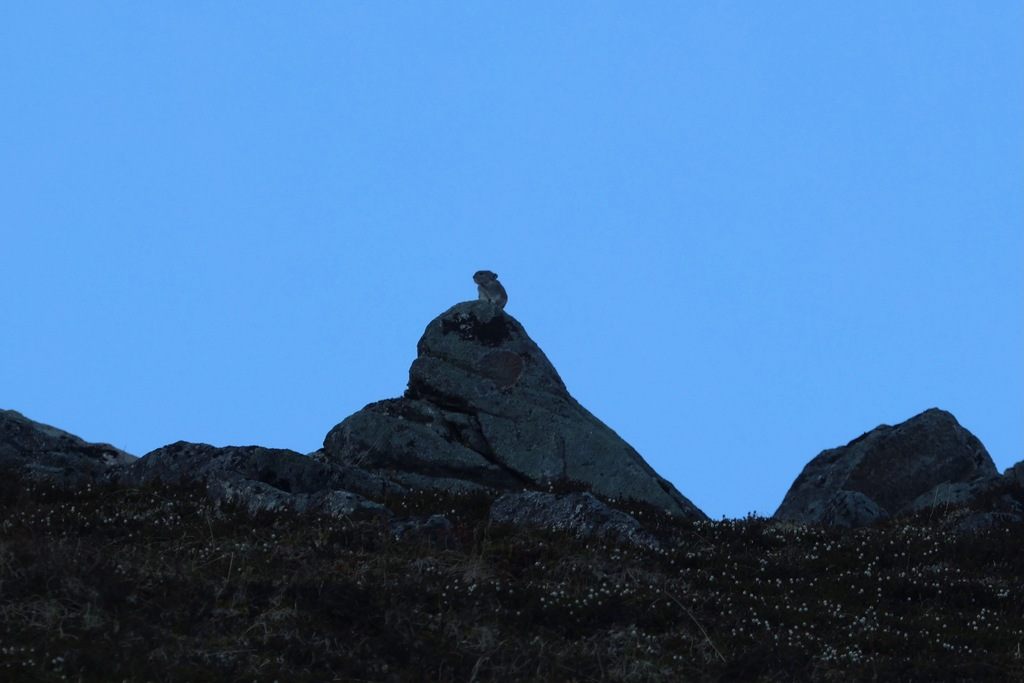
No. Collared pikas never hibernate. All summer they cut and cure grasses into a haypile stashed in a rock crevice, then stay awake inside the talus all winter, eating from that stockpile while the snowpack above insulates them from the Arctic air outside.
Every mammal that lives above the treeline through an Arctic winter needs a survival strategy, and most of them involve some version of sleeping through the worst of it. The collared pika skips that step entirely. It spends the short alpine summer building a pantry instead, then simply stays awake and keeps living through months of snow and sub-zero air. Here's how that actually works, and why the same animal built to survive brutal cold can also die from a single hot afternoon.
Do pikas hibernate?
No. Pikas do not hibernate, not the collared pika of Alaska and the Yukon, and not its close relative the American pika further south in the Rockies. Instead of dropping into torpor, a collared pika stays active all winter, moving through a maze of tunnels and gaps between the rocks of its talus home, eating from a cache of dried vegetation it put up months earlier. There's no long sleep and no slowed heartbeat, just a small, alert mammal running its whole life underneath a lid of snow, closer in strategy to a wolverine toughing out the cold than to a true hibernator.
What is a pika, exactly?
Despite looking like a tailless guinea pig, the pika isn't a rodent at all. It belongs to the order Lagomorpha, the same order as rabbits and hares, in its own family, Ochotonidae. The collared pika (Ochotona collaris) carries 26 teeth, five toes on each front foot and four on each hind foot, and a band of pale grey fur across the nape and shoulders, the "collar" that gives it its name and separates it from the browner-faced American pika (Ochotona princeps) 800 km to the south. At 130 to 200 g and about 18 cm long, it's roughly the size and weight of a small guinea pig, with short rounded ears and essentially no visible tail.
Why do pikas make haypiles?
Because there's no hibernation to fall back on, a pika's winter survival depends entirely on what it stockpiles over a few short weeks of summer. Starting in late June, it clips leaves, grasses, wildflowers and small shrub stems and carries them back to open rock near its den, where they're left to dry and cure in the sun before being moved into a sheltered crevice. A pika may build several small caches scattered through its territory, but usually concentrates on one main haypile, which can grow to around two feet high and two feet across by late summer. Curing matters as much as collecting: fresh-cut plants left to dry in the sun lose some of their natural toxins before they're stored, making the eventual winter diet safer to eat months later. A pika rarely wanders more than about 10 metres from the safety of its talus to gather any of it, foraging close enough to the rocks to dive for cover the instant a predator appears.
Each pika defends its own haypile with real intensity. The species is strongly territorial and largely solitary, holding and guarding an individual patch of talus and vegetation rather than sharing a colony's resources the way some other mountain mammals do. Neighbours are kept in line with a short, sharp, repeated bark that announces a pile is already claimed, and intruders caught stealing cured hay are chased off outright.
How pikas stay warm, and why they can just as easily overheat
Surviving without hibernation means a pika needs serious insulation and a metabolism that runs hot enough to hold a stable body temperature through an Arctic winter. It has both: a thick coat and a metabolic rate that generates heat quickly and loses it slowly. That combination is excellent for January, and a genuine liability in July, a trade-off the dense-coated sable manages for the opposite reason, insulated enough to hear prey moving under 30 cm of Siberian snow. A pika's normal resting body temperature sits only a few degrees below its lethal maximum of roughly 43°C, so direct summer sun for more than a short stretch can be dangerous. The same talus field that shelters its winter tunnels also supplies constant shade, and a pika manages the risk by foraging in short bursts and retreating into cool rock gaps between trips rather than lingering in the open heat.
Winter brings a different version of the same tightrope. A pika doesn't fear the cold air directly, it fears losing the snow that insulates its tunnels from that cold air. Snowpack keeps the space under the talus warmer and more stable than the surface above it, which is what lets an animal with no fat reserves to speak of stay active all winter on a single summer's haypile. When that insulation fails, the consequences are severe: an unusual mid-winter warm spell that thinned the snow cover in the Yukon was linked to roughly 90 percent mortality in the one collared pika population tracked there long-term, a reminder that the margin between "well insulated" and "exposed" is thin at altitude.
Where do collared pikas live?
Collared pikas are found only in talus slopes and boulder fields above the treeline across central and southern Alaska and northwestern Canada, including the Yukon, the Richardson Mountains of the Northwest Territories, and isolated pockets of northwestern British Columbia. Roughly 60 percent of the total population lives in Canada, mostly in the Yukon. A single pika's home range is small, typically around 30 metres across, with separate food caches spaced 30 to 70 metres apart within it. It's a habit shared by other scree-dwelling alpine specialists, the mountain pygmy possum builds its entire life around the same kind of rock-pile shelter, just on the other side of the planet and asleep for most of the year rather than awake.
Collared pika vs American pika
The collared pika and the American pika are easy to tell apart mainly by where you find them: their ranges sit roughly 800 km apart, with the collared pika confined to Alaska and the far northwest of Canada and the American pika occupying the Rockies, the Sierra Nevada and other mountain ranges further south. Where field marks matter, look at the face and skull: the collared pika has creamy-coloured fur around its facial scent glands, where the American pika's equivalent patch is brownish, and its skull is broader with a shorter nasal area. Both species share the same basic playbook, talus habitat, no hibernation, and a haypile built to last the winter, the opposite approach to the true, deep hibernators covered in how hedgehogs survive winter.
How rare is the collared pika in Kaught?
In the Kaught catalog the collared pika sits at the Epic tier, three diamonds out of four. That reflects how often the species is actually confirmed in the wild, not its conservation status. Collared pikas live only on remote, high-elevation talus that few people ever walk across, rarely venture more than 10 metres from their rocks, and fall silent rather than call out when a weasel is nearby, all of which makes a confirmed sighting genuinely uncommon even for someone standing in the right habitat.
Do pikas hibernate: frequently asked questions
Do pikas hibernate?
No. Collared pikas stay active all winter long, moving through tunnels under the snowpack and eating from a haypile they cured and stored during summer. They never enter the deep torpor that true hibernators like the mountain pygmy possum rely on.
What is a pika related to?
Rabbits and hares. Despite its rodent-like look, the pika belongs to the order Lagomorpha in its own family, Ochotonidae, making it a cousin of rabbits, not a rodent at all. It has 26 teeth and a stocky, nearly tailless body built for cold rock.
Why do pikas make haypiles?
Because they don't hibernate, pikas need a winter's worth of food stored somewhere they can reach it under snow. Starting in late June, a pika clips grasses and wildflowers, dries them in the sun on open rock to cure, then stashes the finished haypile in a crevice, a stack that can reach two feet high by late summer.
How big is a collared pika?
Around 18 cm long and 130 to 200 g, roughly the size and weight of a small guinea pig. It has short rounded ears, no visible tail, and a band of pale grey fur across the nape and shoulders that gives it its name.
Can pikas overheat?
Yes, surprisingly easily. A pika's resting body temperature sits only a few degrees below its lethal maximum of around 43°C, so direct summer sun can be dangerous. It limits exposure by foraging in short bursts and retreating into cool rock crevices between trips.
Where do collared pikas live?
In talus slopes and boulder fields above the treeline across Alaska and northwestern Canada, the Yukon, the Northwest Territories and the far north of British Columbia. A pika rarely travels more than about 10 metres from the safety of its rockfall.
Why is the collared pika "Epic" in Kaught?
Kaught's rarity tier tracks how often a species is actually confirmed in the wild, not its conservation status. The collared pika lives only on remote high-elevation talus, rarely strays from its rocks, and freezes silent at the first sign of a predator, so a confirmed sighting is genuinely uncommon.
The next thing you see could be
your first catch.
Kaught is live on the App Store and Google Play. Free to start, and your first catch is one photo away.
Free to start · Live on the App Store and Google Play
Species data, type, rarity tier and measurements, is drawn from the Kaught catalog, built on open biodiversity records from GBIF and iNaturalist. Rarity reflects how often a species is observed in the wild, not its conservation status.