
Behaviour guide
Why do buzzards soar? The common buzzard's aerial hunting strategy
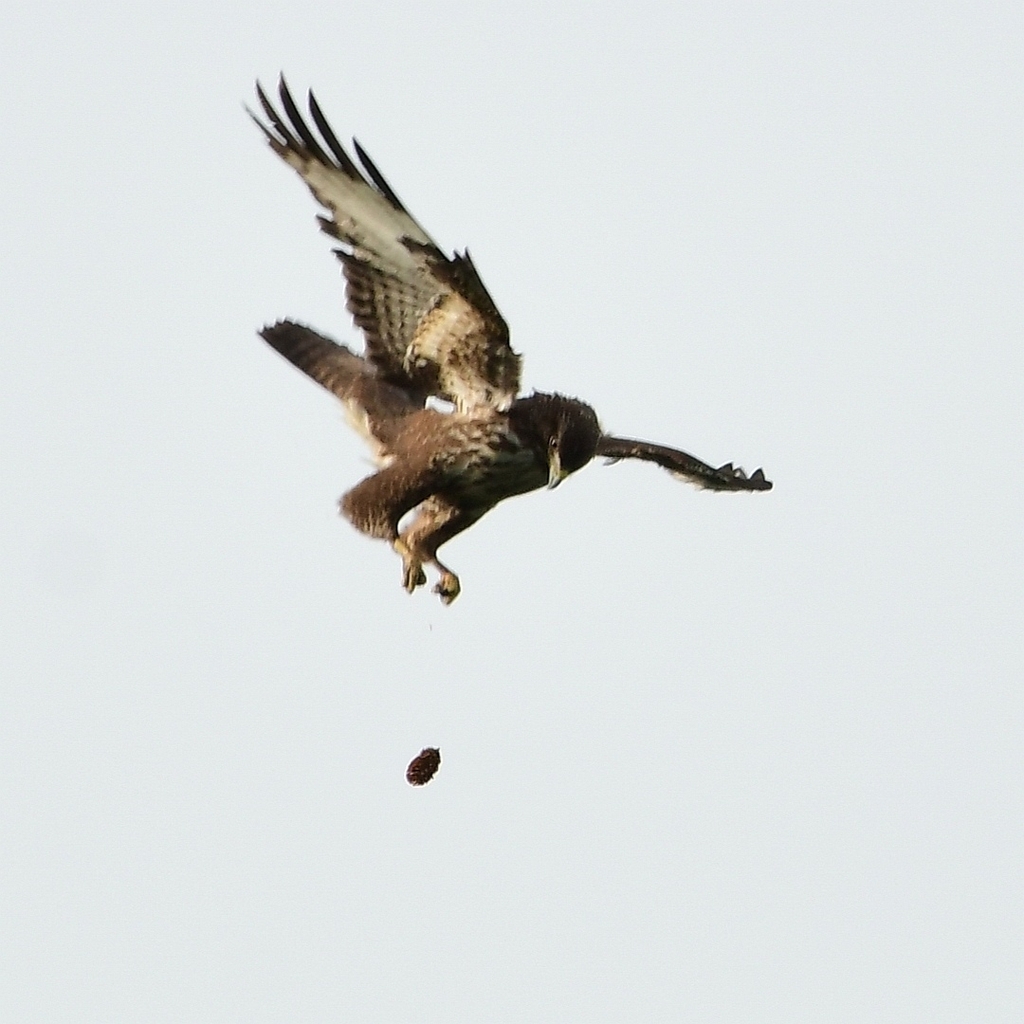
The common buzzard (Buteo buteo) soars on thermals to gain altitude cheaply, using rising columns of warm air as a free lift system. From height it scans a wide area for voles, rabbits and earthworms below, then glides or stoops toward prey. It is one of the most efficient hunting strategies in British raptors.
Look up on a warm June afternoon and there is a good chance something large and broad-winged is circling overhead without a single wingbeat. That is a common buzzard, and it is working, not drifting. Here is what it is actually doing up there.
How thermals work, and why raptors use them
A thermal is a column of warm air rising from sun-heated ground. Dark surfaces like ploughed fields and road tarmac warm faster than surrounding vegetation and send a rising bubble of warm air upward. A bird that finds the core of a thermal can circle inside it and be carried upward with almost no energy expenditure.
For a bird the size of a buzzard, flapping is expensive. Broad wings and a body weight of around 800 g make sustained flapping flight costly. Soaring on thermals solves this: the bird gains height for free, then trades that altitude for distance by gliding to the next thermal. Cross-country soaring birds, from buzzards to storks, operate on exactly this principle.
The shallow V-shape (or dihedral) that a soaring buzzard holds its wings in is not accidental. It is a stable soaring posture that allows small adjustments to stay centred in the rising column without constant correction.
What a buzzard is looking for from altitude
From 200 metres a buzzard can survey a patch of countryside dozens of times larger than it could scan from a fence post. Its visual acuity is estimated at roughly four times that of a human, and its eyes detect a broader spectrum. There is good evidence that raptors can see into the near-ultraviolet range, which would allow them to track the urine trails that voles leave on grass runways, glowing in UV as a road map to prey below.
The prey list is wide. Voles and rabbits form the backbone of the diet. Beetles, earthworms, carrion and frogs are all taken. A buzzard will walk slowly across a ploughed field picking up earthworms, and will follow a tractor for the invertebrates it turns up. The grey heron waits in absolute stillness at the water's edge; the buzzard solves the same problem of locating prey by covering ground from above.
The two hunting modes
Common buzzards use two distinct tactics, often in the same day.
Aerial hunting: soar to altitude on a thermal, glide or circle over likely ground, lock on to movement, and stoop. The stoop is not the vertical power-dive of a peregrine: it is a controlled glide-dive that ends in a grab with the talons. Buzzards prefer to hit slow or stationary prey from this angle rather than chase at speed.
Perch-hunting: sit on a prominent perch, a fence post, dead tree, telegraph pole or motorway gantry, and watch. When something moves in the vegetation below, drop onto it. This method is cheaper than soaring and works well on overcast days when thermals are weak. It is why you so often see buzzards on roadside posts along motorway verges: the short grass makes prey visible, and the fence provides the perfect vantage point.
How to identify a common buzzard
From below, look for:
- Shape: large, broad wings with a distinctly "fingered" tip from the spread primary feathers. Short, rounded tail. Compact-bodied compared to an eagle.
- Dihedral: wings held in a shallow V when soaring, not flat like a sparrowhawk or raised like a red kite.
- Carpal patch: a dark mark at the bend of each wing on the underwing surface. Visible even on very pale individuals, this is the most consistent field mark.
- Plumage: extremely variable, from almost white below to very dark brown. Most birds show a pale belly and a darker chest band, but do not rely on colour alone.
- Call: a far-carrying, mewing "pee-yow" that carries across a valley. Regularly mistaken for a cat.
When and where to see them
Warm, sunny days from late morning onward produce the strongest thermals and the best soaring. June and July are ideal: long days, reliable sun, and this year's young birds beginning to fly from woodland nests near the forest edge. Look over farmland with a patchwork of fields and copses, motorway verges with post-perches, and valley slopes where contrasting ground surfaces generate reliable thermals.
Early mornings are quieter. Overcast days push them onto fence posts. A buzzard motionless on a roadside post in grey weather is doing exactly the same job as the one spiralling overhead in sunshine: watching and waiting.
How rare is the common buzzard in Kaught?
The buzzard sits at Rare in the Kaught catalog: two diamonds out of four. That reflects observation frequency, not population. Buzzards are widespread across the UK, but they spend much of their time at altitude or perched quietly in treetops, making a close, confirmed sighting less common than a garden robin. See the full UK rarity tier ranking to see how it compares across the catalog.
Common buzzard: frequently asked questions
Why do buzzards soar in circles?
They are riding thermals: columns of warm air rising from sun-heated ground. Circling inside the thermal carries the bird upward with almost no energy expenditure. From altitude it surveys a wide area for prey, then glides down toward anything it spots. It is efficient hunting, not aimless drifting.
How do you identify a common buzzard in flight?
A large, broad-winged raptor with a short rounded tail, wings held in a shallow V when soaring. The most reliable field mark is a dark carpal patch at the wrist of each wing. Plumage varies widely but the carpal patches are usually visible. Call: a far-carrying mewing "pee-yow".
What do buzzards eat?
Mainly voles and rabbits, plus beetles, earthworms, carrion, frogs and occasionally small birds. They walk across ploughed fields for earthworms and follow tractors to catch invertebrates turned up by the blades.
When is the best time to see buzzards soaring?
Warm sunny days from late morning onward, when thermals are strongest. June and July are ideal. Look over farmland near woodland edges, motorway verges and valley slopes where sun heats contrasting ground surfaces.
How rare is the common buzzard in Kaught?
Rare: two diamonds out of four. Kaught's rarity reflects actual observation frequency, not population size. Buzzards are widespread but spend much of their time high up or perched quietly in trees, making a close clear sighting less common than many garden species.
The next thing you see could be
your first catch.
Kaught is live on the App Store and Google Play. Free to start, and your first catch is one photo away.
Free to start · Live on the App Store and Google Play
Species data, type, rarity tier and measurements, is drawn from the Kaught catalog, built on open biodiversity records from GBIF and iNaturalist. Rarity reflects how often a species is observed in the wild, not its conservation status.