
Species spotlight
Tufted Puffin: the black seabird with a golden mane and an orange ship's prow of a bill
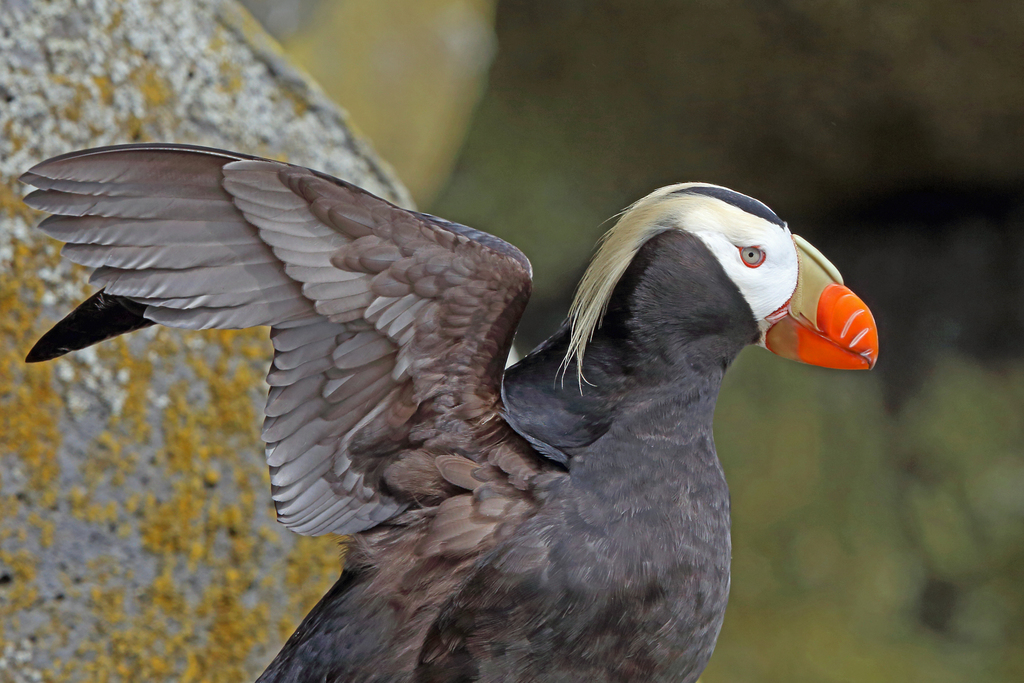
The tufted puffin (Fratercula cirrhata) is the largest of the three puffin species, a crow-sized seabird with an all-black body, white face, massive orange-red bill and long golden head tufts that grow each breeding season. It nests on clifftop islands across the North Pacific from California to Japan, spending the rest of the year at sea.
There are three puffin species. The Atlantic puffin gets the tourism posters. The horned puffin lives quietly beside it in Alaska. The tufted puffin is the odd one out: all-black where the others are white-breasted, dramatically fringed with golden head tufts, and a genuine open-ocean bird that spends most of the year nowhere near land. It is also the largest, and by most measures the hardest to see.
Field marks
In breeding plumage (roughly May to September), the tufted puffin is unmistakable:
- Body: all-black, including the underparts. This alone sets it apart from the Atlantic and horned puffins, which have white breasts.
- Face: a clean white facial patch.
- Bill: enormous, laterally compressed, orange-red with yellow ridges. The tip curves downward like the prow of a ship. In size and shape it rivals the Atlantic puffin's bill.
- Tufts: long, straw-yellow plumes that curl back from above and behind each eye, sometimes reaching 10 cm, sweeping back like a 1970s pop star's hair in a headwind. Both sexes grow them.
- Eyes: small, pale yellow-white, set into the white face like a pair of dots.
In winter plumage the tufts are shed, the face darkens to grey-brown, and the outer sheath of the bill is moulted away, leaving a much smaller, darker bill. A winter-plumage tufted puffin at sea is a substantially less spectacular bird.
Where to find one
The tufted puffin breeds on the Farallon Islands off San Francisco, on rocky headlands and islands north through Oregon, Washington and British Columbia, across Alaska and the Aleutian chain, and west through Kamchatka to Hokkaido in Japan. The largest colonies are in Alaska.
Best access points for non-expedition birders:
- Oregon Coast: haystack rocks at Cannon Beach and Three Arch Rocks host accessible breeding colonies visible from shore in summer.
- Kenai Fjords, Alaska: boat tours out of Seward reliably reach nesting cliffs in the fjords.
- Hokkaido, Japan: small populations breed on offshore islands near Rausu and Rishiri.
Outside the breeding season the tufted puffin disperses across the open North Pacific, rarely coming close enough to shore to be seen without a pelagic birding trip. That open-ocean lifestyle, combined with the remoteness of most breeding colonies, explains its Legendary tier in the Kaught catalog: four diamonds, reflecting the genuine rarity of a confirmed sighting for most observers.
What the golden tufts are for
The tufts, formally called auricular plumes, are grown each spring and shed each autumn. They are not unique to males: both sexes develop them. Field studies on related puffin species show that birds in better physical condition grow longer, more symmetric plumes. Rivals and prospective mates assess plume length and symmetry before and during pairing, making the tufts a reliable, annually renewed signal of individual quality.
The bill also plays a role in display. The bright orange-red colour is most vivid at peak breeding condition, fading through the season. Some studies suggest the colour saturation carries information about parasite load and immune function, again a condition signal that benefits honest assessment.
Diving and feeding
Puffins are alcids, the seabird family that uses its wings to fly underwater as well as through air. The tufted puffin dives from the surface, folds its wings and uses them to swim in pursuit of fish and squid at depths of up to 60 m. Pursuit dives can last up to a minute.
When bringing fish back to the burrow for a chick, a tufted puffin carries them crosswise in its bill, sometimes 10 or more small fish held simultaneously. The trick requires the bird to catch and hold each new fish without dropping the ones already there, achieved using a combination of backward-pointing tongue spines and the notched inner surface of the bill.
Primary prey varies by colony location: capelin and sand lance in Alaska, anchovies and herring off California, pollock in the Aleutians. Like many diving seabirds, the tufted puffin can adjust dive targets based on local fish availability rather than being locked to a single prey species.
Nesting
Tufted puffins nest in burrows: either self-excavated tunnels up to 1.5 m long in cliff-top soil, or natural rock crevices. A single egg is laid in late May or early June. Both parents incubate for about six weeks, then feed the single chick for another six weeks before it fledges. The chick leaves the burrow at night (to reduce predation risk) and takes to sea alone, where it spends its first winter learning to fish independently.
Birds reach breeding age at around five years and typically pair for multiple seasons, returning to the same burrow each year.
Tufted Puffin: frequently asked questions
How do you identify a tufted puffin?
In breeding plumage: all-black body, white face, large orange-red bill, and long golden tufts sweeping back from above each eye. In winter the tufts are lost, the face darkens and the bill shrinks. Larger and darker than Atlantic or horned puffins.
Where do tufted puffins live?
Breeding colonies on clifftop islands from central California north to Alaska and west to Kamchatka and Hokkaido. Outside breeding season they live in the open North Pacific Ocean, rarely approaching shore.
What are the tufted puffin's golden tufts for?
The tufts (auricular plumes) are grown each breeding season by both sexes. Longer, more symmetric tufts signal better body condition. Rivals and prospective mates assess them when choosing partners.
What do tufted puffins eat?
Fish (capelin, sand lance, anchovies, herring, pollock) and squid, caught by diving from the surface and using wings to swim underwater. They carry multiple fish back to the burrow simultaneously, held crosswise in the bill.
Why is the tufted puffin Legendary in Kaught?
Kaught's rarity reflects how often a species is observed in the wild. Tufted puffins breed on remote offshore islands and spend most of the year at sea far from shore. A confirmed sighting requires a colony visit or pelagic trip, placing them at the Legendary tier, four diamonds.
The next thing you see could be
your first catch.
Kaught is live on the App Store and Google Play. Free to start, and your first catch is one photo away.
Free to start · Live on the App Store and Google Play
Species data, type, rarity tier and measurements, is drawn from the Kaught catalog, built on open biodiversity records from GBIF and iNaturalist. Rarity reflects how often a species is observed in the wild, not its conservation status.