
Superlative ranking
Loudest animals in the world: 6 record-holders ranked by decibels
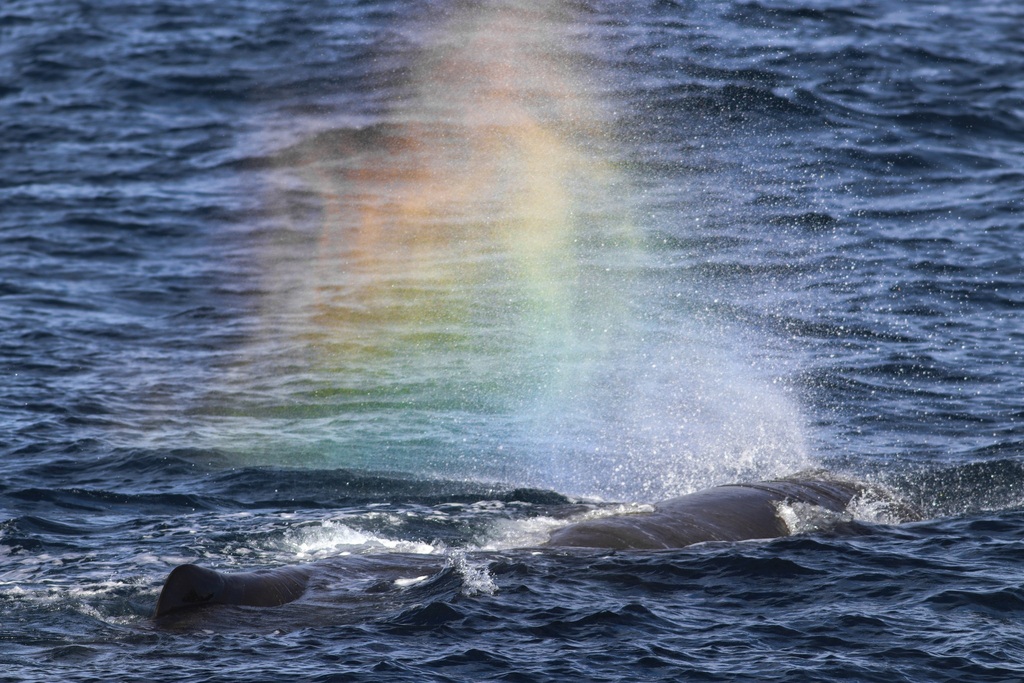
The sperm whale produces the loudest confirmed animal sounds at up to 230 dB (in water). On land, the mantled howler monkey reaches 128 dB, audible over 5 km. The European mole cricket sings from a self-built acoustic burrow at 115 dB. Each record is driven by a different physical mechanism, and each animal carries a Kaught catalog card.
A note before the ranking: decibels in water and air use different reference levels, so you cannot directly compare an underwater whale click at 230 dB to a lion's roar at 114 dB as if they are the same scale. The numbers here reflect each species' measured peak output in its medium. Where the record is underwater, that is stated. The ranking orders them from largest peak sound pressure level recorded, medium noted.
1. Sperm Whale, up to 230 dB (in water)
The sperm whale's spermaceti organ, the massive square forehead that gives the species its distinctive silhouette, is the largest sound-producing structure in the animal kingdom. A single click lasts less than one millisecond. The peak measured pressure of that click reaches 230 dB re 1 µPa at 1 m (the standard underwater reference), which roughly translates to 170 dB in air terms, still louder than a jet engine at 30 m.
These clicks are not calls or vocalisations in the social sense. They are echolocation pulses: the whale fires a narrow beam forward and listens for the reflection off prey, typically giant squid, at depths of up to 2,000 m where no light penetrates. At maximum power, the outgoing click may be intense enough to stun or disorient prey at close range, though this remains debated.
Sperm whales also produce slower, more rhythmic click patterns called codas that function as individual signatures and group dialects, the equivalent of accent and name. Those codas are far quieter than echolocation pulses.
2. Greater Bulldog Bat, ~137 dB at source (ultrasonic, inaudible to humans)
Bats emit echolocation calls to navigate and hunt, and some species push those calls to extreme intensities. The greater bulldog bat, a large fishing bat of Central and South American coastlines and rivers, emits pulses measured at around 137 dB at the source. The catch: these pulses are ultrasonic, typically 50 to 80 kHz, well above the 20 kHz upper limit of human hearing. They would not register as sound to anyone standing next to the bat.
The greater bulldog bat hunts fish by dragging its oversized feet and claws through the water surface, detecting ripples made by fish near the surface using its echolocation. The high intensity of the pulses allows it to detect and track small surface disturbances at speed in darkness.
Its call intensity makes it among the loudest animals by source level, but the ultrasonic frequency and the rapid fading of high-frequency sound in air mean it is effectively inaudible over more than a few metres to any creature that can hear it.
3. Mantled Howler Monkey, up to 128 dB
The loudest land animal by peak sound pressure level is not the lion, the elephant, or any large carnivore. It is a medium-sized New World monkey that weighs around 7 kg. The mantled howler monkey produces a deep, resonating howl that carries across 5 km or more of closed-canopy tropical rainforest, measured at up to 128 dB near the animal.
The mechanism is structural. The howler monkey has an enormously enlarged hyoid bone in the throat, a modification that creates a resonating chamber almost unique in the primate order. The larger the hyoid, the lower and louder the howl. Groups chorus at dawn and in response to other groups, announcing territory without physical confrontation. The call that filters through the forest canopy is a deep, echoing roar that sounds, to anyone hearing it for the first time, like nothing recognisably primate.
There is a trade-off: males with the largest hyoids tend to have smaller testes, suggesting that the energetic investment in vocal apparatus comes at a reproductive cost. Loud males carry one advantage but not all of them.
4. European Mole Cricket, ~115 dB
The European mole cricket does something no other known animal does: it excavates a purpose-built acoustic amplifier into the ground before it sings. The male digs a burrow with a double-horn shape at the entrance, shaped precisely to maximise the amplification of his wing-stridulation frequency. Measured from outside the burrow, his call reaches approximately 115 dB, comparable to a chainsaw at close range.
The mole cricket produces sound by rubbing a hardened scraper on one wing across a file of small teeth on the other, a process called stridulation. Without the burrow, this generates a relatively quiet sound. With it, the energy is directed upward through the horns and amplified as efficiently as a musical instrument's body. Studies modelling the burrow geometry found that it operates within a few percent of the theoretical acoustic optimum, and is rebuilt to the same dimensions each season.
The song is a sustained churring at around 3.5 kHz, audible on warm still nights from several hundred metres. The mole cricket itself is rarely seen: it lives underground, uses those same powerful forelegs for digging and swimming, and surfaces mainly to fly to new patches of damp soil or to reach a female attracted by the call.
5. Lion, ~114 dB
The lion's roar is the most recognisable animal call on Earth. Measured at close range it reaches approximately 114 dB, audible to humans from 8 km in open savanna and further across water. Both sexes roar. Roaring is used to advertise territory, to locate separated pride members, to intimidate rival coalitions, and sometimes as part of the chorus that lions perform together after dark.
The mechanism is a specialised larynx: lions (along with the other big cats in the genus Panthera) have square, flat vocal folds rather than the triangular folds of smaller cats. This geometry allows the folds to stretch under low tension and vibrate at the low frequencies that carry across open distances, producing the characteristic deep, resonating boom rather than a high-pitched screech.
A full roar sequence typically builds through a series of moans, peaks at a thundering full roar, then trails off into a series of grunts. The whole sequence can last several minutes and is often followed immediately by others in the pride or coalition.
6. Ash Cicada, ~106 dB
Cicadas are the loudest insects in most of the world where they occur. The ash cicada, a Mediterranean species common in scrubby woodland around the Adriatic, Aegean and eastern Mediterranean, produces calls measured at around 106 dB: the equivalent of a rock concert or a power drill at arm's length. Unlike the mole cricket, cicadas produce sound with a completely different mechanism.
The male has a pair of stiff membranes on the abdomen called tymbals. Rapid muscles click these membranes in and out of a buckled position several hundred times per second. The abdomen is largely hollow, acting as an amplification chamber. The sound is produced as a continuous, high-pitched trill that in warm Mediterranean summers creates the iconic ambient noise of the region, overlapping from dozens of calling males in a single stand of trees.
Females of most cicada species are mute. Males produce the call from perches in trees, and the directionality can be controlled somewhat by adjusting the position of the abdomen. Some cicada species synchronise their calls into mass choruses, so the combined volume of a large colony in a small area can exceed any individual's output by a substantial margin.
How to compare these records fairly
A few caveats the list requires:
- The sperm whale record is measured in water against an underwater reference. The equivalent in-air intensity is lower, though still extraordinary.
- The greater bulldog bat call is ultrasonic. Any nearby human would hear nothing. The intensity at source is real but the medium and frequency make it a separate category from audible sounds.
- The mole cricket is louder per unit body mass than almost any animal on the list, amplifying a small insect to chainsaw levels from underground.
- Decibels are logarithmic: a 10 dB increase represents roughly a tenfold increase in sound intensity. The sperm whale's 230 dB (water) to the ash cicada's 106 dB is not "twice as loud" but many orders of magnitude more intense.
What these six animals share is a genuine acoustic record, each the product of a different evolutionary solution to the problem of being heard at distance. The sperm whale solved it with a spermaceti organ the size of a car engine. The mole cricket solved it with architecture. The howler monkey solved it with a bone. All six appear in the Kaught catalog.
Loudest animals: frequently asked questions
What is the loudest animal in the world?
The sperm whale, with echolocation clicks reaching 230 dB in water. These are brief pulses rather than sustained calls, but at that intensity they are the loudest confirmed animal sounds on record, equivalent to roughly 170 dB in air.
What is the loudest land animal?
The howler monkey. The mantled howler (Alouatta palliata) can reach 128 dB, audible over 5 km of dense rainforest. An enlarged hyoid bone in the throat acts as a resonating chamber, amplifying the call without requiring large body size.
What is the loudest insect?
By output relative to body size, the European mole cricket. The male excavates a horn-shaped burrow that amplifies his call to around 115 dB, comparable to a chainsaw at close range. Cicadas are also extremely loud, with some reaching 106 dB or more.
Can animals make sounds humans cannot hear?
Yes. The greater bulldog bat emits ultrasonic echolocation calls at around 137 dB at source, far above the 20 kHz upper limit of human hearing. Elephants also communicate using infrasound too low for human perception.
Why do decibels compare strangely between water and air?
Decibels measure pressure relative to a reference level. The reference in water is lower than in air, so a dB reading in water and in air are not directly comparable. A 230 dB whale click in water equates to roughly 170 dB in air terms, still louder than a jet engine.
The next thing you see could be
your first catch.
Kaught is live on the App Store and Google Play. Free to start, and your first catch is one photo away.
Free to start · Live on the App Store and Google Play
Species data, type, rarity tier and measurements, is drawn from the Kaught catalog, built on open biodiversity records from GBIF and iNaturalist. Rarity reflects how often a species is observed in the wild, not its conservation status.