Exotic spotlight
Nile Monitor Lizard: Africa's largest lizard and how it hunts
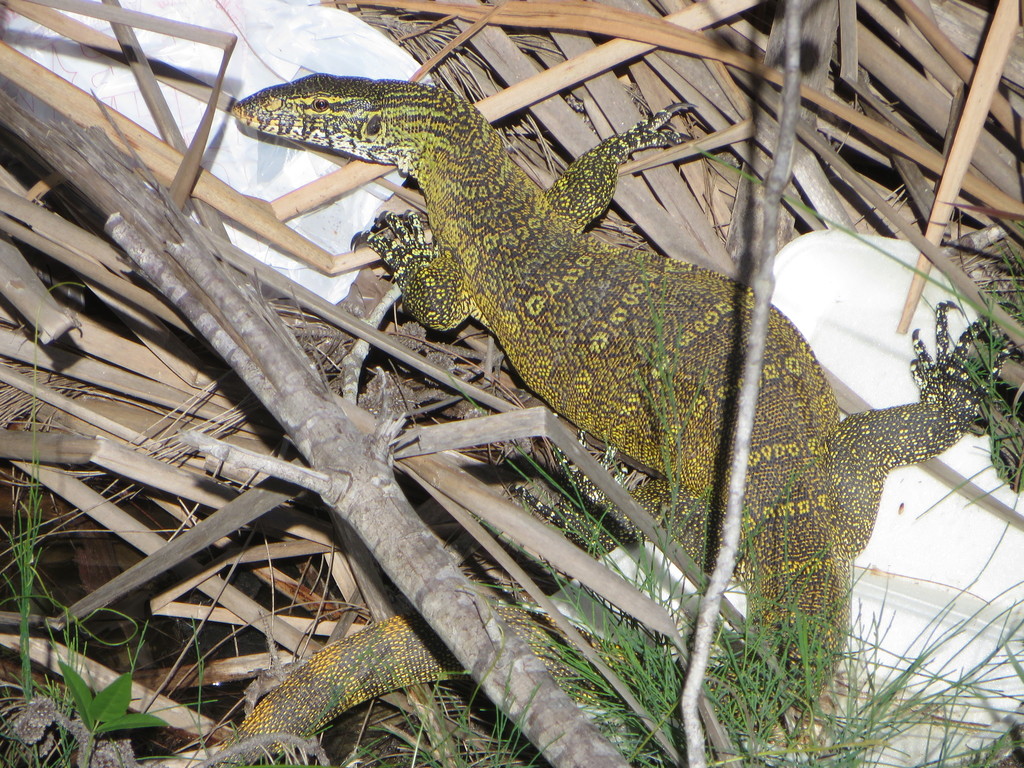
The Nile monitor (Varanus niloticus) is Africa's largest lizard, reaching over 2 metres and 20 kg, a semi-aquatic apex predator found along rivers and lakes across sub-Saharan Africa. It can sprint at nearly 30 km/h, swim powerfully, and will defend itself hard if cornered, though it prefers to vanish.
Stand at the edge of any African river and watch the bank. The rough-textured log half-submerged at the waterline might blink. The Nile monitor is so good at holding still that it is regularly mistaken for debris, right up until it launches into the water at speed and vanishes.
How to identify a Nile monitor
Size is the first clue: adults are unmistakably large for a lizard. Key features:
- Body: powerfully built, with a broad flat head, muscular legs and a long laterally compressed tail that is half the total length.
- Scales: dark grey to black above with yellow or white spots and ocelli (eye-spots) arranged in rows across the back and tail.
- Tongue: long, forked and bright blue, flicked constantly to sample scent in the air.
- Movement: on land it walks with a reptilian sway, but runs with surprising agility. In water the body flattens and the tail sculls from side to side like a crocodile's.
Young monitors are more brightly patterned than adults, with stronger yellow-and-black banding that fades with age.
Where Nile monitors live
Nile monitors are found across virtually all of sub-Saharan Africa, from Senegal in the west to Somalia in the east, and south to South Africa. They also follow the Nile into Egypt. The common thread is permanent water: they're almost always within reach of a river, lake, wetland or coastal estuary where they can forage and escape predators by diving.
They've adapted well to human-altered landscapes and are common around villages, irrigation canals and fish farms, where food and water are reliable.
What Nile monitors eat
The Nile monitor's diet is a masterclass in opportunism. It eats fish, frogs, crabs, snails, small mammals and birds, carrion, and, most famously, eggs. It locates crocodile and bird nests by following scent trails with its forked tongue, then excavates them with powerful claws. It can crack the shells of large crocodile eggs with its jaws.
It also eats other reptiles, including smaller monitors, and is one of very few animals that consistently raids Nile crocodile nests, doing so sometimes in coordinated pairs, one animal distracting the guarding female while the other digs.
How the Nile monitor hunts
The forked tongue is central to everything. Monitors belong to the family Varanidae, and like all varanids they use vomeronasal (Jacobson's) organs in the roof of the mouth to analyse chemical signals picked up by the tongue tips. The two forks effectively give the animal a directional smell, allowing it to follow scent gradients to a buried nest or drifting carrion the way we follow a sound to its source.
In water, monitors hunt by sight and feel, pursuing fish into shallows and probing under rocks with their snout and claws. On land they cover ground methodically, flicking the tongue every few steps, following the strongest chemical trail.
Is the Nile monitor dangerous?
A large adult Nile monitor commands respect. The bite is powerful enough to break fingers; the claws are designed to excavate hard soil and are not gentle on skin; and the muscular tail is used as a whip when threatened, capable of leaving a welt. That said, unprovoked attacks on people are uncommon. The monitor's first response to a person is almost always rapid retreat: into the water if possible, up a tree if not.
The risk is highest when an animal is cornered or when someone attempts to pick one up. Do not do this with a wild Nile monitor.
How fast is a Nile monitor?
Nile monitors have been clocked sprinting at around 29 km/h over short distances, fast enough that a human would struggle to outrun one over 20 metres. In water they are even more at home, using the tail to propel themselves and able to hold their breath for up to an hour while hiding from a threat on the bottom of a riverbed.
Three things that make the Nile monitor remarkable
- The cooperative nest raid: pairs of monitors have been observed working together to rob Nile crocodile nests, one distracting the guarding female while the other digs, one of the few documented examples of coordinated deception in reptiles.
- Heart-rate control: during breath-holding dives, Nile monitors can drop their heart rate dramatically, extending dive times and conserving oxygen, a level of cardiovascular control unusual in lizards.
- Invasive range: brought to Florida as pets and subsequently released, Nile monitors have established feral populations in the counties around Cape Coral, where they prey on local wildlife including the burrow owl and gopher tortoise.
Nile monitor: frequently asked questions
How big do Nile monitor lizards get?
Typically 1.5 to 2 metres in total length; exceptional individuals can exceed 2.5 metres. Large adults weigh up to 20 kg, making the Nile monitor Africa's largest lizard by both length and mass.
How fast can a Nile monitor run?
They can sprint at around 29 km/h over short distances. In water they are equally capable, using the tail to propel themselves and able to hold their breath for up to an hour.
Are Nile monitors dangerous to humans?
A large monitor can cause serious injury with its bite, claws and tail if cornered or handled. However, attacks on people who keep their distance are rare; the animal's default response is to flee.
What do Nile monitors eat?
Fish, frogs, crabs, snails, bird and crocodile eggs, small mammals, carrion and other reptiles. They locate buried eggs by following scent trails with their forked tongue.
Where do Nile monitors live?
Throughout sub-Saharan Africa and along the Nile into Egypt, always near permanent water. They're adaptable and common near villages, canals and fish farms.
The next thing you see could be
your first catch.
Kaught launches soon. Join the waitlist and be first to start a collection of the living world, one photo at a time.
Free at launch · No spam, just one email on launch day
Species data, type, rarity tier and measurements, is drawn from the Kaught catalog, built on open biodiversity records from GBIF and iNaturalist. Rarity reflects how often a species is observed in the wild, not its conservation status.