Legendary spotlight
King Rail: the marsh bird that fills the air with sound and refuses to be seen
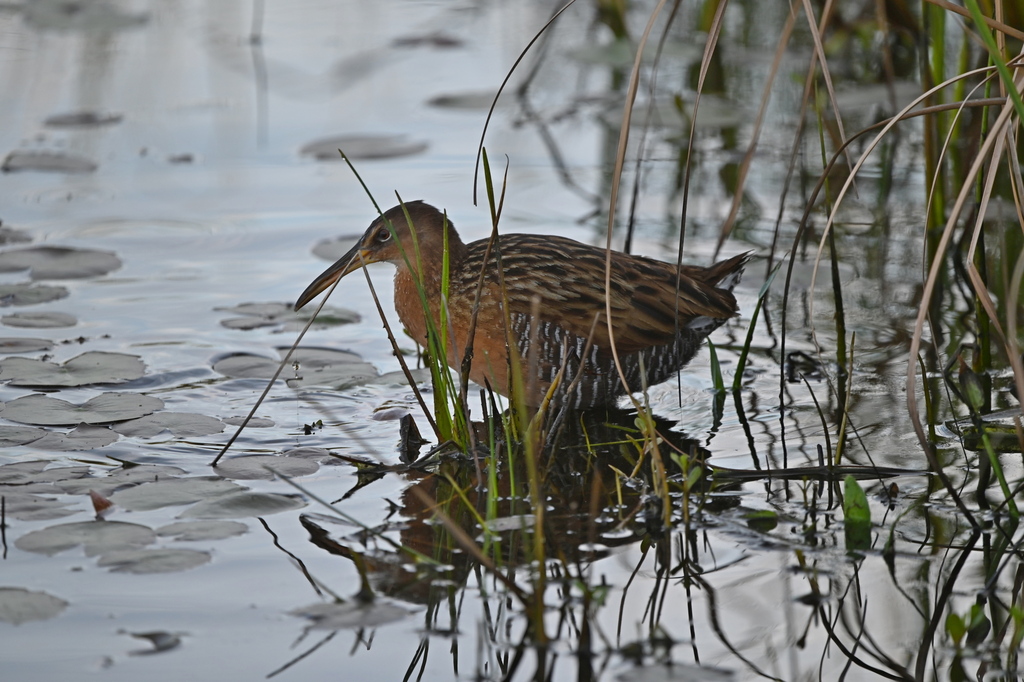
The king rail (Rallus elegans) is North America's largest rail, a chicken-sized, cinnamon-breasted marsh bird that calls loudly from the heart of freshwater cattail swamps yet is almost never seen. Its body is so narrow it slips between reed stems without disturbing them. Hearing one from an arm's length and seeing nothing is a rite of passage for North American birders.
There is a particular frustration reserved for rail-watchers. The bird calls from directly in front of you, the reeds are barely moving, you are standing at the very edge of the marsh, and you see absolutely nothing. Then it calls again from six feet to your left. This is the king rail experience, and it is the reason the species sits at the Legendary tier in the Kaught catalog.
How to identify a king rail
On the occasions when one steps into view, identification is straightforward:
- Size: noticeably large for a rail, roughly chicken-sized. At 38 to 48 cm it is about twice the size of the familiar Virginia rail.
- Breast: a rich, warm cinnamon-orange, brightest on the chest and fading toward the belly.
- Back: dark brown and black, heavily streaked, providing camouflage in reed stems.
- Bill: long, slightly down-curved, and used for probing mud and water for invertebrates.
- Legs: long and greenish-grey, adapted for walking over floating vegetation and through soft mud.
The clapper rail is superficially similar but is typically paler, greyer and saltier, being a coastal marshes species rather than a freshwater one. In the rare zone of overlap the king rail's deeper cinnamon colour and heavier streaking are the key differences.
The call: your best chance of a record
The king rail's primary advertisement call is a rapid, descending series of low, mechanical notes: "kek-kek-kek-kek-kek," starting fast and slowing toward the end, delivered with a ventriloquial quality that makes the source nearly impossible to pinpoint. At dusk it adds a grunting, pig-like groan, and during territorial disputes both sexes produce a cackling clatter.
Dawn and dusk in spring and early summer are the peak times, when males call persistently from breeding marshes. In many areas a birder's only confirmed record of king rail is a sound recording made at the edge of a marsh they never managed to see into.
Where king rails live
King rails are birds of freshwater marshes, specifically the dense, interior reaches dominated by cattail, bulrush and sedge where the water is shallow and crayfish are plentiful. They breed across a broad swath of eastern North America, from the Great Plains states east to the Atlantic coast and south through the Mississippi valley to the Gulf Coast. They winter primarily in coastal marshes and rice fields in the southeastern United States.
A key requirement is dense emergent vegetation with interspersed pools of shallow open water. Marshes that have been degraded or opened up tend to be abandoned.
Why rails are so hard to see: biology of invisibility
The phrase "thin as a rail" originated with these birds, and it is literal. Rails' bodies are laterally compressed: if you measure across the widest point of the torso, king rails are narrower than they look. They walk sideways through reed stems that appear impossibly tight, pushing through without moving the vegetation.
Pair this with streaked brown-and-black plumage that exactly matches a background of dried cattail stems and shadow, and a behavioural preference for walking rather than flying, and you have an animal that is acoustically conspicuous and visually undetectable. Even experienced ornithologists go seasons without a definitive visual record of a calling bird.
What king rails eat
The king rail's diet is anchored by crayfish, which it seizes in the bill, pins to the mud with its foot, and dismantles with a series of sharp pecks before swallowing. It also takes aquatic insects and larvae, snails, small fish, frogs, seeds and aquatic plant material. Foraging happens mainly in shallow water or at the waterline, often at the very edge of cover.
Three things you didn't know about the king rail
- It can compress its skeleton: rails have evolved a rib structure that allows the chest to flex inward, letting the bird squeeze through gaps smaller than its relaxed body width.
- Its chicks are black: king rail chicks hatch as tiny balls of black down, making them almost invisible in the dark interior of marsh vegetation, a stark contrast to the warm colours of the adults.
- It hybridises with the clapper rail: where freshwater and saltwater marshes meet along the Atlantic coast, king rails and clapper rails occasionally interbreed, producing fertile hybrids that combine features of both species.
King rail: frequently asked questions
What does a king rail look like?
A large, chicken-sized marsh bird with a cinnamon-orange breast, dark brown and black streaked back, a long slightly down-curved bill and long legs. About 38 to 48 cm long, it is roughly twice the size of the Virginia rail.
What does a king rail sound like?
A rapid, descending series of low 'kek' notes, slowing toward the end: "kek-kek-kek-kek." Also grunting, groaning and pig-like squealing sounds, especially at dusk and dawn during the breeding season.
Where do king rails live?
Freshwater marshes dominated by cattail, bulrush and sedge across eastern North America. They winter in coastal marshes and rice fields in the southern United States.
Why are king rails so hard to see?
Their bodies are laterally compressed, narrow enough to slide sideways through reed stems without moving them. Combined with cryptic brown plumage and a preference for dense vegetation, they can call from two metres away and be completely invisible.
What do king rails eat?
Mainly crayfish, aquatic insects and larvae, snails, small fish, frogs and seeds. They forage in shallow water and at the waterline, usually just inside cover.
The next thing you see could be
your first catch.
Kaught launches soon. Join the waitlist and be first to start a collection of the living world, one photo at a time.
Free at launch · No spam, just one email on launch day
Species data, type, rarity tier and measurements, is drawn from the Kaught catalog, built on open biodiversity records from GBIF and iNaturalist. Rarity reflects how often a species is observed in the wild, not its conservation status.