Adaptation explainer
How do snakes swallow prey larger than their own head?
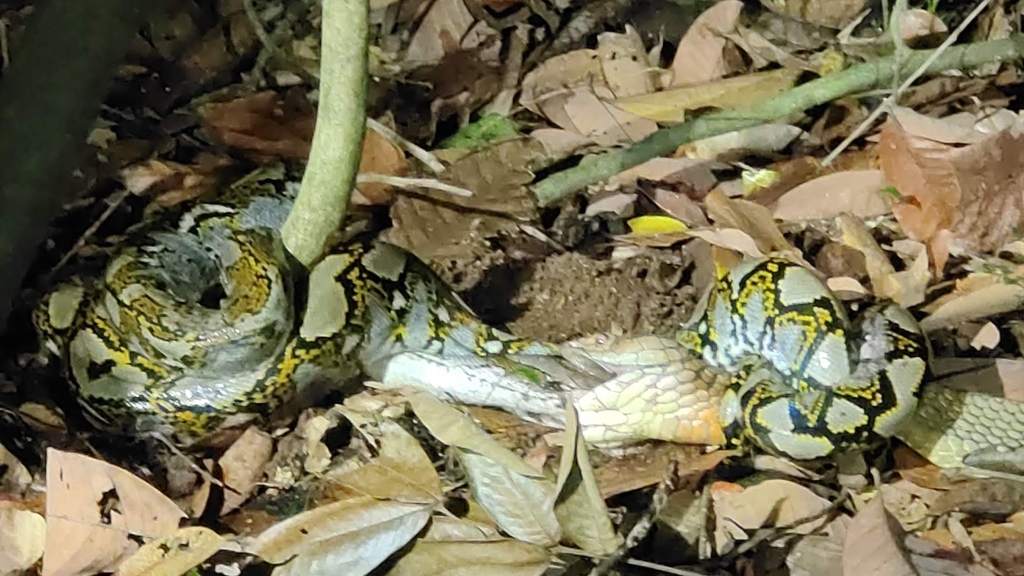
Snakes can swallow prey far larger than their head because their skull is not one rigid box but a collection of loosely articulated bones, their lower jaw is two separate halves connected only by a stretchy ligament, and their skin can expand to many times its resting diameter. The reticulated python, the world's longest snake, takes this to its furthest extreme.
The reticulated python is the world's longest snake. Reliable records push past 7.6 metres. A large female can weigh 150 kg and eat a pig. None of this makes biological sense until you understand what a snake's skull actually is, and what happens to a python's body after it swallows something big.
The myth of the dislocated jaw
It is almost universally stated that snakes "dislocate" their jaws to eat. This is not quite right, and the actual truth is more interesting.
In most vertebrates, including humans, the lower jaw is a single fused bone attached firmly to the skull at the temporomandibular joint. A snake's lower jaw is two separate bones, each attached to the skull at a flexible joint and connected to each other only at the chin by an elastic ligament, not fused bone. This means each half of the lower jaw can swing out independently, spreading wide and then moving alternately forward to "walk" prey down the throat.
The upper jaw is no less mobile. Snake skulls are described as kinetic: rather than one rigid box, they are assemblages of bones connected by flexible joints that allow the roof of the mouth, the palate and the sides of the skull to expand outward as prey passes through. The reticulated python has evolved this system to an extreme that allows it to consume prey with a body diameter several times its own resting head width.
How the swallow actually works, step by step
Once prey has been subdued (by constriction in pythons, by venom in vipers and cobras), the snake begins the swallow:
- Orient to head-first: snakes almost always begin swallowing at the head of the prey. This causes limbs to fold back along the body rather than catching on the throat walls.
- Uncouple the jaw halves: the lower jaw splits at the chin and each side spreads outward, gripping the prey with rows of sharp, rearward-curved teeth that act as ratchets, holding the prey while the other side advances.
- Alternating jaw walk: each lower jawbone moves forward in turn, biting into the prey and pulling the head over it, then the other side repeats. The snake does not push the prey; it pulls itself over the prey.
- Skin and muscle expand: the skin of the neck and body is folded in microscopic accordion pleats at rest, allowing it to stretch to several times its resting circumference. Muscles separate along their fibres to let the prey pass.
- Glottis extended: throughout this process, the snake extends its tracheal opening (glottis) to the front of the mouth, keeping an airway open even when the throat is completely blocked.
For a very large meal, a python may take 20 minutes or more to complete the swallow. The prey bulge is clearly visible tracking down the body afterward.
What happens inside after the meal
This is where the reticulated python's biology becomes genuinely extraordinary. Between large meals, a python's digestive organs shrink dramatically, reducing metabolic costs during a fast that may last weeks or months. When a large meal arrives, the organs must rapidly scale back up to handle the digestive load.
Within 24 to 48 hours of a big meal:
- The heart grows by up to 40% to pump blood to the rapidly expanding digestive system.
- The liver and intestines double or triple in mass as they upregulate digestive enzymes.
- The stomach acidifies dramatically: gastric pH drops to between 1 and 2, among the most acidic environments in any vertebrate, capable of dissolving bone.
- Metabolic rate spikes by up to 44 times resting level, generating enough internal heat that a digesting python is measurably warmer than its surroundings.
Once digestion is complete, typically in four to eight days for a large meal, all of these organ expansions reverse and the snake returns to its resting state. This on-demand organ scaling is being studied as a model for understanding cardiac hypertrophy in humans.
Why the reticulated python takes this furthest
Most snakes eat prey no larger than their own head in resting state. Pythons, and particularly the reticulated python, have taken the kinetic skull system to a scale that allows consumption of prey that would be simply impossible for other snakes. The combination of extreme body length, a highly flexible skull, powerful muscular constriction before the swallow (which compresses and stretches the prey carcass, making it easier to process), and an industrial-scale digestive response makes the reticulated python the single most capable swallowing machine in the snake world.
How long can a python go without eating?
Reticulated pythons and other large constrictors can go a year or more between meals when large prey is scarce. Their resting metabolic rate is so low, and their ability to downsize their own organs so effective, that they can survive extended fasts that would kill a mammal of equivalent size in weeks.
How snakes swallow: frequently asked questions
Do snakes really dislocate their jaws to swallow prey?
Not exactly. Their lower jaw is two separate halves joined only by an elastic ligament, and their skull bones are loosely articulated rather than fused. This gives a very large gape without any joint actually dislocating.
How do snakes breathe while swallowing?
They extend the glottis (tracheal opening) to the front of the mouth, keeping an airway open even when the throat is completely blocked by prey. They breathe normally throughout.
How long does it take a snake to digest a large meal?
A large python digesting a big meal typically takes four to eight days to fully process it. The snake's heart, liver and intestines temporarily grow to handle the load, then shrink back.
Can a snake's stomach acid dissolve bones?
Yes. Snake gastric pH drops to between 1 and 2 during active digestion, among the most acidic in any vertebrate. Bones, teeth and most cartilage dissolve completely; fur and feathers typically pass through.
What is the largest animal a snake has ever swallowed?
Reticulated pythons are documented eating adult pigs, deer and, in rare confirmed cases, humans. The largest reliably recorded prey weigh around 50 to 60 kg.
The next thing you see could be
your first catch.
Kaught launches soon. Join the waitlist and be first to start a collection of the living world, one photo at a time.
Free at launch · No spam, just one email on launch day
Species data, type, rarity tier and measurements, is drawn from the Kaught catalog, built on open biodiversity records from GBIF and iNaturalist. Rarity reflects how often a species is observed in the wild, not its conservation status.