
Evolution story
Maned Wolf: the South American animal that is neither wolf nor fox
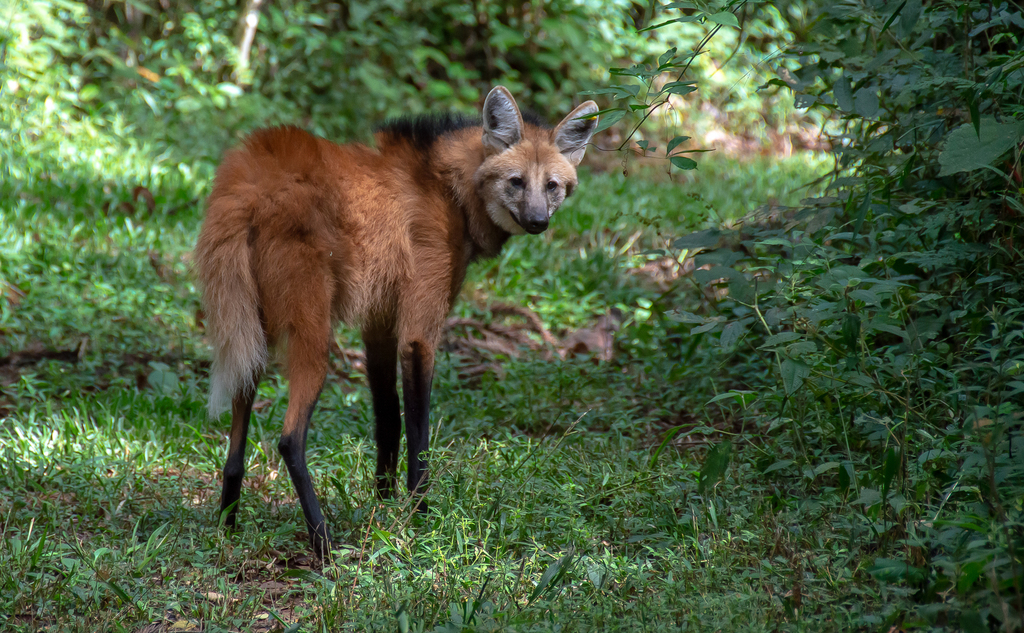
The maned wolf (Chrysocyon brachyurus) is a large South American canid that belongs to its own genus with no close living relatives. It looks like a red fox mounted on stilts, howls like a wolf, and eats more fruit than most omnivores. It is not a wolf. It is not a fox. It is something else entirely.
Look at a maned wolf and you see a fox that someone stretched on a rack. The colouring is fox-red, the pointed face is fox-shaped, and the black stockings on the legs match a red fox's dark socks. But nothing else does. The legs are improbably long. The mane of dark fur across the shoulders and nape rises when the animal is threatened. The call is a roar-bark that carries 3 km across the cerrado. This is not a fox, and a closer look at where it sits on the canid family tree explains why.
Where does the maned wolf fit in the family tree?
The family Canidae contains wolves, foxes, jackals, dogs, and a scatter of South American canids that diverged from the main lineage when the Americas joined roughly 3 million years ago. Those South American species form their own clade, and the maned wolf is one of them. Its genus, Chrysocyon, contains exactly one species. It has no close living relatives at all: its nearest cousin is probably the bush dog (Speothos venaticus), a compact pack-hunter of the Amazon basin that looks nothing like it.
The red-fox resemblance is convergent evolution: the maned wolf and the red fox evolved similar colour patterns and facial shapes independently, in different continents, from different ancestors. The body plan that works for a fox hunting voles in a European meadow turns out to work similarly for a canid hunting rodents in South American grassland. Nature found the same solution twice.
The legs: an adaptation to the cerrado
The maned wolf's legs account for most of the visual surprise. At the shoulder it stands around 90 cm, taller than most dogs and considerably taller than any fox. The legs are not built for speed: the maned wolf tops out at around 55 km/h, unremarkable for a large canid. They are built for elevation.
The cerrado, the tropical savanna of central Brazil, is dominated by tall grass that can grow above waist height. A predator with short legs sees a wall of stems. A predator standing 90 cm at the shoulder sees over them. The maned wolf hunts by spotting prey at distance and approaching in a high-stepping trot, lifting each leg clear of the grass. The legs are the equivalent of stilts, not sprinting shoes.
What the maned wolf eats: predator and gardener
Up to half the maned wolf's diet is fruit. That figure surprises people who see a large canid and assume a meat-heavy diet. The most important single food item is the wolf apple (Solanum lycocarpum), a large, tomato-like fruit native to the cerrado. The maned wolf eats so many wolf apples that the plant depends on it as a seed disperser: the seeds pass through the gut unharmed and germinate in the animal's dung, often far from the parent plant.
Beyond fruit, the maned wolf takes small mammals (particularly armadillos, rodents and rabbits), birds, reptiles, frogs and insects. It hunts alone, not in packs: pairs share a territory and a den site, but each animal forages independently. A typical night involves trotting several kilometres of grassland, stopping to stamp one foot rapidly on the ground, listening for movement beneath, then pouncing.
The call: roar-bark
The maned wolf's vocalization is called a roar-bark: a deep, resonant call that carries across 3 km of open cerrado. Pairs use it to stay in contact. The call is not lupine in the musical sense of a wolf howl, but it is unmistakably large and powerful for an animal that otherwise looks foxy. First-time listeners in the field consistently describe it as unsettling. It is the sound of something that does not map neatly onto existing categories.
The smell: skunk wolf
The maned wolf's scent-marking secretion is notoriously strong. In parts of Brazil the animal has earned the nickname lobo-guará (maned wolf) but also more informal names referencing the smell, which is frequently compared to cannabis or skunk spray. The secretion comes from anal scent glands and is used to mark territory. A single animal can hold a territory of up to 90 km², and the scent posts it leaves every few hundred metres are the primary way it communicates across that space.
There is a practical consequence: a zoo that housed a maned wolf received a call from Rotterdam police in 2006, following complaints about a cannabis smell from the direction of the zoo. The culprit was No. 134 in the Kaught catalog.
How rare is it to see a maned wolf?
In the Kaught catalog the maned wolf sits at Rare, two diamonds out of four. That reflects how often it is actually observed, not a conservation statement. It is nocturnal, solitary, and inhabits a vast and sparsely monitored biome. A maned wolf that crosses a field camera is an event. Seeing one in the wild, eyes glowing orange in torchlight above the grass line, is genuinely uncommon even for cerrado researchers who spend years in the field.
The fact that it has persisted and remains geographically widespread is a measure of how well that long-legged, fruit-eating, roar-barking evolutionary oddity has solved the cerrado's particular puzzle.
Maned wolf: frequently asked questions
What is the maned wolf?
The maned wolf (Chrysocyon brachyurus) is a large South American canid that belongs to its own genus with no close living relatives. It is neither a wolf nor a fox. Its nearest relative is the bush dog, a small Amazonian canid. The fox-like colouring is a case of convergent evolution.
Where does the maned wolf live?
The cerrado: the vast tropical grassland and savanna of central South America. Its range covers most of Brazil's interior, Bolivia, Paraguay, northern Argentina and Peru. It prefers open grassland with scattered shrubs and patches of gallery forest.
What does the maned wolf eat?
Up to 50% fruit, most importantly the wolf apple, plus small mammals, birds, reptiles and insects. This makes it simultaneously predator and seed disperser: the wolf apple depends on the maned wolf to spread its seeds.
Why does the maned wolf have such long legs?
To see over tall cerrado grass. The legs are an elevation adaptation, not a speed adaptation. The maned wolf high-steps through grass to spot prey from above, then pounces, rather than running prey down over open ground.
Is the maned wolf dangerous?
No. It is shy and avoids people. No attacks on humans have been recorded. Its size can be startling but its temperament is consistently secretive and flight-prone.
Why is the maned wolf Rare in Kaught?
Kaught's rarity reflects observation frequency, not conservation status. The maned wolf is nocturnal, solitary, and lives across a huge, sparsely monitored biome. Confirmed sightings are infrequent, which places it at the Rare tier of two diamonds out of four.
The next thing you see could be
your first catch.
Kaught is live on the App Store and Google Play. Free to start, and your first catch is one photo away.
Free to start · Live on the App Store and Google Play
Species data, type, rarity tier and measurements, is drawn from the Kaught catalog, built on open biodiversity records from GBIF and iNaturalist. Rarity reflects how often a species is observed in the wild, not its conservation status.