
Exotic spotlight
Australian Giant Cuttlefish: the world's largest cuttlefish and its extraordinary mating show
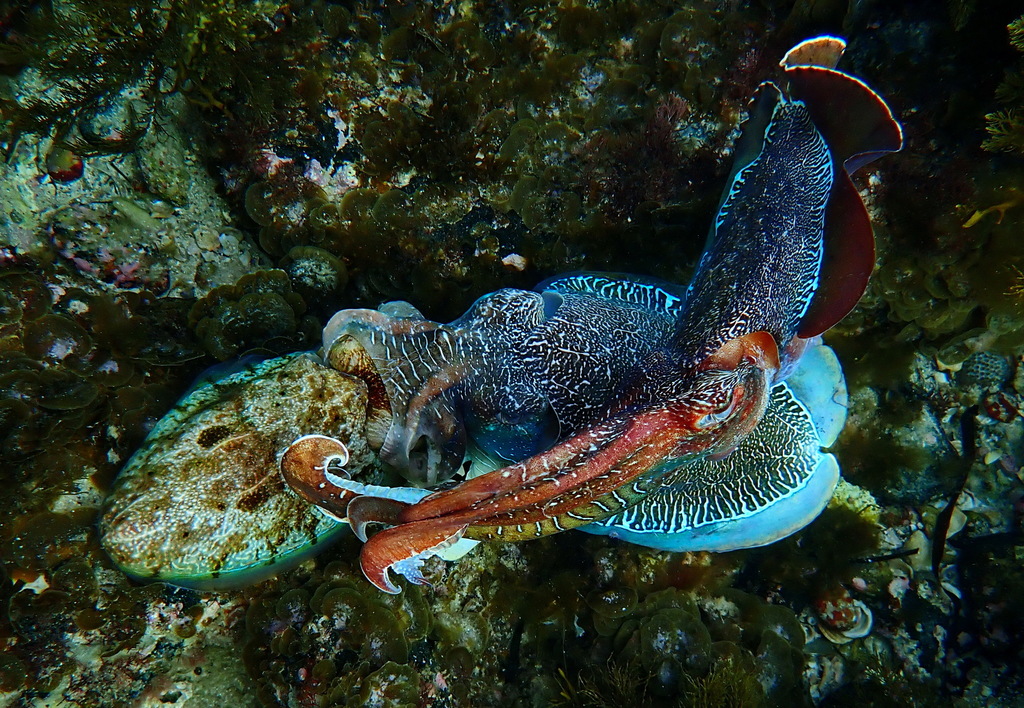
The Australian giant cuttlefish (Sepia apama) is the world's largest cuttlefish by mass, reaching 50 cm and 10.5 kg. Each winter, tens of thousands gather in Spencer Gulf in South Australia to mate in the most concentrated cuttlefish aggregation on Earth. Its colour-shifting skin can replicate any pattern in less than a second. July is peak season.
Off the coast of South Australia, roughly 250 km north of Port Augusta, there is a stretch of shallow rocky reef called Point Lowly. Every winter from May to August, tens of thousands of Australian giant cuttlefish converge here. The density at peak can reach four animals per square metre. The water turns brown with bodies. Each individual carries an animated light show across its skin, rippling bands of colour shifting in real time. Divers who have seen it describe it as the most surreal 30 minutes they have ever spent underwater.
The world's largest cuttlefish
Cuttlefish are cephalopod mollusks: the group that includes octopuses, squid and nautiluses. They have eight arms, two longer feeding tentacles, a rigid internal shell called the cuttlebone, and three hearts pumping blue-green blood. The Australian giant cuttlefish is the largest species in the family Sepiidae by mass, reaching 10.5 kg for large males, a body mass that exceeds any octopus species found in warm waters.
Outside the aggregation site, giant cuttlefish are solitary ambush predators. They hunt fish and crustaceans by hovering motionless above the reef, then extending their two feeding tentacles at speeds too fast to follow, snatching prey in sucker-covered clubs. The tentacles retract in under 15 milliseconds. The animal then paralysed prey with its beak, which is the only hard structure in an otherwise entirely soft body.
The colour system: three layers of instant change
The giant cuttlefish's skin contains three layers of specialised cells, working together to produce colour changes in less than a second:
- Chromatophores: elastic sacs of pigment (yellow, red, brown, black) controlled directly by muscles. When a muscle contracts, the sac stretches from a dot to a disc roughly 15 times its resting size, flooding the skin with that colour. Relax the muscle and the sac snaps back to invisible.
- Iridophores: cells packed with reflective protein platelets that produce structural colour and iridescence, the same physics that makes soap bubbles rainbow-coloured. These create blues, greens and the shimmering metallic quality of the skin.
- Leucophores: white cells beneath the others that scatter light uniformly, providing a bright background or baseline.
The skin can also change texture: muscular papillae raise and flatten to add three-dimensional pattern on top of the colour pattern. A giant cuttlefish against a rocky reef can look indistinguishable from the surrounding substrate. Against seagrass, it matches the blade colour, the stem orientation, and the play of light through the water above it.
All of this is done by an animal that is almost certainly colourblind. Cuttlefish have a single type of photoreceptor (compared with three in humans, sixteen in mantis shrimp), yet produce colour patterns of extraordinary precision. The leading theory is that they use pupil shape to sample colour information: the strange W-shaped pupil may sample different wavelengths at different positions, functioning as a crude spectrophotometer. The exact mechanism is still debated.
The mating aggregation: two strategies running at once
The Point Lowly aggregation is not just about numbers. It is a site of intense competition that reveals two entirely different male reproductive strategies operating in the same water at the same time.
Strategy 1: display and guard. Large males claim positions beside females and run spectacular colour displays: pulsing bands rolling across the mantle, arm postures extended, body size maximised. These displays are directed at rivals and potential mates simultaneously. A successful large male can guard a female for hours, driving off challengers with chromatic threat displays.
Strategy 2: female mimicry. Small males cannot compete in a display contest. Instead, they switch to a different program: they flatten the body to female dimensions, change the mantle colour to female pattern (including simulating the egg string that females show after laying), and position the arms to mimic a female's tentacle arrangement. Then they approach the pair, looking to the dominant male like a non-threatening female. Once close enough to the actual female, they switch briefly back to male display, mate, and retreat.
Both strategies produce offspring. Research tracking genetic parentage at Point Lowly has found that small-male sneaker copulation accounts for a significant fraction of fertilisations. The aggregation is, among other things, an evolutionary arms race between recognition and deception running in real time.
The lifespan: two years to do everything
The Australian giant cuttlefish lives for approximately two years. That is all. The aggregation at Point Lowly marks the end of life for most participants: adults mate, lay eggs in crevices in the reef, and die. The eggs hatch as fully formed miniature cuttlefish, with all the chromatophore machinery already functional. Juveniles disperse and grow through a solitary year before returning to the same reef site for their single breeding season.
For an animal with this lifespan, the cognitive profile is remarkable. Giant cuttlefish pass versions of the delayed gratification test, choosing to wait for a preferred food item over an immediately available lesser one. They recognise individual human faces. They navigate complex environments and learn from observation. Concentrating that much cognitive machinery into two years of life, and then spending it all in a single season's spectacular aggregation, is one of the more extraordinary life histories in the animal kingdom.
How to see one
The Point Lowly aggregation, near Whyalla on the Eyre Peninsula, is accessible by snorkel. Water depth at the site is shallow enough that full scuba equipment is not required. Peak season runs from June to August, with July typically the most productive month. Conditions change quickly: clear water after a calm period is better than churned water after wind. Local dive operators run guided trips from Whyalla.
Outside the aggregation season, the giant cuttlefish is far harder to find. It inhabits rocky reef and kelp beds across southern Australia from Ningaloo Reef in Western Australia to Sydney in the east. Sightings are solitary, uncommon, and typically brief: the animal's camouflage means most encounters involve watching something that looks like a rock suddenly pulse with colour and jet away.
In the Kaught catalog it sits at Rare, two diamonds out of four, reflecting genuine observation scarcity outside its aggregation window. See related cephalopod articles at vampire squid and wonderpus octopus.
Australian giant cuttlefish: frequently asked questions
What is the Australian giant cuttlefish?
The Australian giant cuttlefish (Sepia apama) is the world's largest cuttlefish species by mass, reaching up to 50 cm mantle length and 10.5 kg. Endemic to southern Australia, it is best known for a spectacular annual winter aggregation in Spencer Gulf where tens of thousands gather to mate.
Where can you see the giant cuttlefish aggregation?
The world's largest known cuttlefish aggregation occurs at Point Lowly near Whyalla, Spencer Gulf, South Australia, from May to August each year. July is typically peak. The site is shallow and accessible by snorkel. Local operators in Whyalla run guided trips.
How do cuttlefish change colour?
Three layers of specialised cells work together: chromatophores (muscle-controlled pigment sacs that expand in under a millisecond), iridophores (reflective protein platelets that produce structural colour and iridescence), and leucophores (white scatter cells). A full colour and texture change takes less than a second.
Are cuttlefish intelligent?
Yes. Cuttlefish pass delayed gratification tasks, recognise individual humans, navigate complex environments, and learn from watching others. The giant cuttlefish has a lifespan of only two years but the largest brain-to-body ratio of any invertebrate, and its cognitive performance is genuinely impressive.
How do male cuttlefish compete for mates?
Two strategies run simultaneously. Large males display and guard females with chromatic threat displays. Small males cannot compete directly, so they mimic females in colour, shape and arm posture, infiltrate a guarded pair, and mate before retreating. Both produce offspring. Genetic studies show sneaker mating accounts for a significant fraction of fertilisations.
Why is the giant cuttlefish Rare in Kaught?
Kaught's rarity reflects observation frequency, not conservation status. The Australian giant cuttlefish is endemic to southern Australia, lives in rocky reef habitats few people visit, and is genuinely uncommon outside the Spencer Gulf aggregation window. That places it at Rare, two diamonds out of four.
The next thing you see could be
your first catch.
Kaught is live on the App Store and Google Play. Free to start, and your first catch is one photo away.
Free to start · Live on the App Store and Google Play
Species data, type, rarity tier and measurements, is drawn from the Kaught catalog, built on open biodiversity records from GBIF and iNaturalist. Rarity reflects how often a species is observed in the wild, not its conservation status.