
Adaptation explainer
Coyote: how North America's most adaptable predator conquered the city
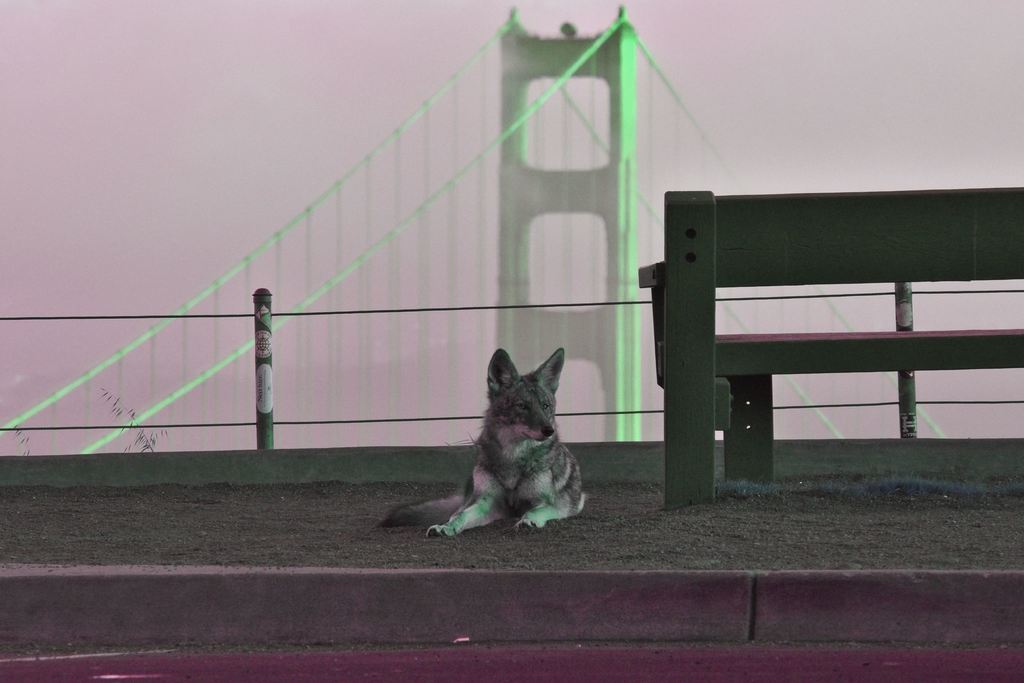
The coyote (Canis latrans) is the only large predator in North America whose range has expanded since European settlement. While wolves, mountain lions and bears retreated, the coyote spread into every US state and every major city. It now lives in New York's Central Park, downtown Los Angeles, and the green corridors of Toronto. This is the story of how.
Every other large predator in North America has a version of the same story: abundant before European contact, heavily persecuted through the 1800s and 1900s, reduced to remnant populations in remote areas. The coyote has the opposite story. Before 1850 it lived mainly in the Great Plains and southwestern deserts. By 2026 it inhabits all of Canada, all of the United States, Mexico, and Central America down to Panama. It crossed into New England in the early 1900s, reached Florida in the 1970s, and established breeding populations in New York City by the 1990s. The range has tripled.
How to identify a coyote
The coyote looks like a lean, slightly undersized dog with a pointed face and a bushy tail. Key field marks:
- Build: rangy and narrow, with long legs relative to body mass. Weighs 7 to 21 kg; eastern coyotes, which carry some wolf ancestry, tend toward the higher end.
- Face: sharply pointed muzzle, large triangular ears that stand erect, and narrow amber-yellow eyes.
- Tail: bushy, with a black tip, and carried low or horizontal when running. Dogs typically carry their tail higher; wolves carry theirs straight out.
- Coat: grizzled grey-brown on the back, tawny or rust on the face and legs, pale underneath. Colour varies considerably, with some individuals appearing almost black or very pale.
- Gait: a trot that looks almost mechanical in its efficiency, covering ground steadily without the loping looseness of a dog.
The call is unmistakable: a series of high-pitched yips rising to a long howl. A group calling together produces a sound that seems to come from far more animals than are actually present, an acoustic illusion caused by the overlapping harmonics of multiple individuals.
Adaptation 1: flexible social structure
Most large canids have fixed social structures: wolves live and hunt in packs, foxes are primarily solitary. The coyote does both, and shifts between them based on resource availability. In areas of abundant small prey, a single coyote hunts alone and maintains a territory. Where deer or large prey are available, two coyotes pair up and hunt cooperatively. Where food is scarce and densely distributed (such as in an urban centre with many small food sources), loose extended family groups form.
This plasticity is the engine of the expansion. A coyote can reorganise its social behaviour to exploit whatever food structure a new habitat presents. It does not need a pack to function. It does not need to be solitary either.
Adaptation 2: dietary opportunism
The coyote's diet is one of the most flexible of any North American carnivore. Rabbits and rodents form the backbone in most habitats, supplemented by deer (hunted cooperatively in winter), birds, reptiles, insects, fruit, berries, carrion and, in urban settings, rats, Canada geese, cats and food waste. Seasonal analysis of scat shows the diet shifting month by month as prey availability changes.
This flexibility matters for range expansion: a species that requires a specific prey type cannot colonise habitats where that prey is absent. A species that can eat almost anything can colonise almost anywhere. The coyote moved into eastern forest by switching emphasis from rabbits to white-tailed deer fawns in spring, when deer populations in eastern states were at their highest density.
Adaptation 3: learned avoidance of persecution
Coyotes were hunted, trapped and poisoned extensively throughout the 20th century. Across the United States and Canada, millions of individuals were killed in predator control programmes. The species responded not with population decline but with compensatory reproduction: when a coyote territory opens, neighbouring animals move in and breeding pairs increase litter size. Research shows that litter size increases as population density decreases, up to a maximum of around 12 pups per litter.
The result is that control programmes consistently failed to reduce coyote populations in the long run. Removing a breeding pair typically resulted in the territory being repopulated within weeks, sometimes by more animals than were removed. This reproductive elasticity is unusual among large carnivores and is a major reason the coyote thrived under conditions that drove other species to local extinction.
Adaptation 4: urban cognition
Urban coyotes have been studied intensively since the Chicago Urban Coyote Project began in 2000, and the behaviour differences between rural and urban individuals are striking. Urban coyotes:
- Are mostly nocturnal in cities, avoiding peak human activity hours, but shift toward daytime activity in low-traffic periods.
- Cross roads by waiting at intersections and observing traffic patterns, a behaviour documented by camera trap footage.
- Maintain smaller home ranges where food is dense (urban territories average 4 to 8 km², compared to up to 50 km² in rural areas).
- Avoid human contact while exploiting human-associated food sources (rodents drawn by buildings, landfills, food waste, ornamental fruit trees, pet food left outdoors).
The coyote did not evolve in cities. It learned to use them. That distinction, between adaptation embedded in genetics over evolutionary time and learned behavioural flexibility acquired within an individual lifetime, is what sets it apart from every other large predator that has encountered urban North America.
The coywolf: eastern hybrids
Coyotes that expanded into eastern North America in the early 20th century encountered remnant wolf populations in southern Ontario and bred with them. The result is sometimes called the "eastern coyote" or "coywolf": an individual that carries roughly 60 to 75 percent coyote ancestry, 10 to 25 percent wolf, and a small percentage of domestic dog genetics. Eastern coyotes are measurably larger than western ones (up to 21 kg vs 7 to 14 kg for western plains coyotes), have broader heads and more powerful jaws, and more readily prey on white-tailed deer. They are still classified as coyotes and the hybrid zone is now stable.
Is the coyote dangerous?
Attacks on adults are essentially unknown. Attacks on small children and pets are rare but occur near areas where coyotes have been fed. The rules are the same as for any wild canid: do not feed them, keep small pets supervised near dawn and dusk, and make noise if you encounter one at close range. A coyote that has not been conditioned to associate people with food will leave at the first sign of human activity.
In the Kaught catalog the coyote sits at Epic, three diamonds out of four. Despite its expanding range, it is primarily nocturnal and most urban individuals are expert at avoiding daytime detection. A confident sighting of a coyote in natural hunting behaviour is less common than you might expect from an animal that may be walking your neighbourhood after midnight. See other North American wildlife at bald eagle and American alligator.
Coyote: frequently asked questions
What is a coyote?
The coyote (Canis latrans) is a medium-sized North American canid, the same genus as wolves and domestic dogs but its own distinct species. It weighs 7 to 21 kg, resembles a lean pointed-faced dog with a bushy black-tipped tail, and its range now covers all of North America from Alaska to Panama.
Where do coyotes live?
Originally western grassland and desert. Now: every US state, all Canadian provinces, Mexico, and Central America. Urban populations are established in New York, Los Angeles, Chicago, Toronto, Montreal and most other major North American cities, where they breed and raise pups in parks and green corridors.
What do coyotes eat?
Almost anything. Rabbits and rodents form the core diet; deer are taken cooperatively in winter. In cities they eat rats, geese, feral cats, fruit and food waste. The dietary flexibility is the primary driver of their range expansion.
Are coyotes dangerous to people?
Rarely. Attacks on adults are essentially unknown. Small children and small pets carry a low risk near active coyote areas. Never feed coyotes: a fed animal loses its fear of people. Make noise if one approaches at close range.
How do you tell a coyote from a wolf or dog?
Coyotes are smaller than wolves (7 to 21 kg vs 30 to 80 kg) and have a pointed, narrower face than most dogs. The tail is bushy with a black tip, carried low when running. The call, a series of yips rising to a howl, is unlike any domestic dog sound.
Why is the coyote Epic in Kaught?
Kaught's rarity reflects observation frequency. Coyotes are primarily nocturnal and most urban individuals actively avoid daytime detection. A confident clear sighting of a coyote in natural behaviour is infrequent, placing it at Epic, three diamonds out of four.
The next thing you see could be
your first catch.
Kaught is live on the App Store and Google Play. Free to start, and your first catch is one photo away.
Free to start · Live on the App Store and Google Play
Species data, type, rarity tier and measurements, is drawn from the Kaught catalog, built on open biodiversity records from GBIF and iNaturalist. Rarity reflects how often a species is observed in the wild, not its conservation status.