
Species spotlight
Superb Starling: East Africa's most iridescent bird, and how that colour works
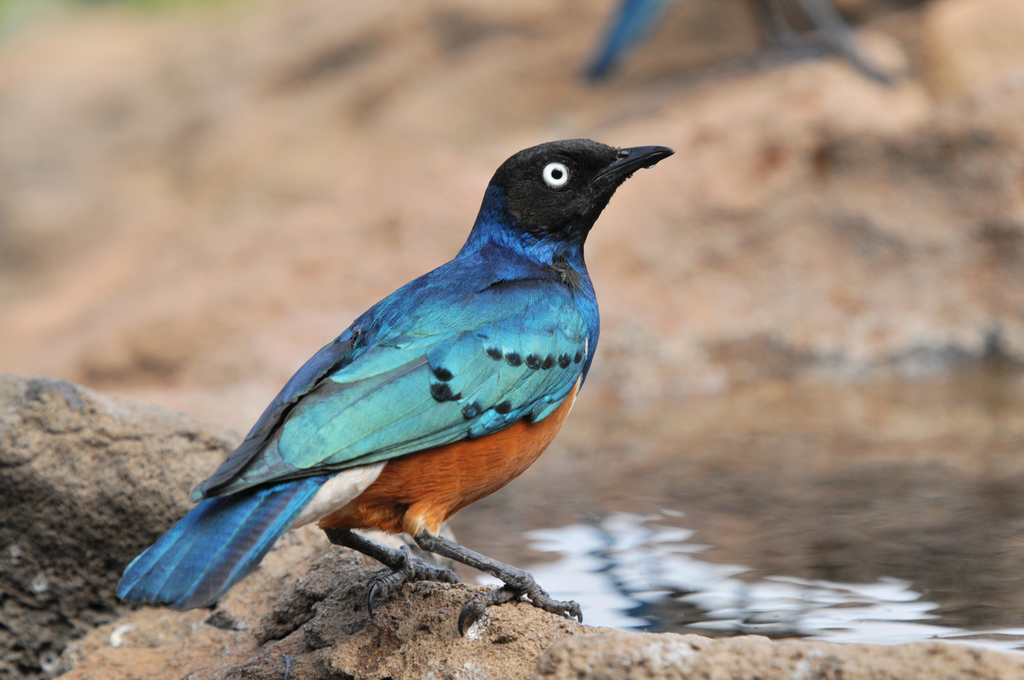
The superb starling (Lamprotornis superbus) is one of East Africa's most visually striking birds: iridescent blue-green above, chestnut below, with a white breast band. Its metallic sheen is structural, not pigment. It lives in acacia savanna from Ethiopia to Tanzania, forages on the ground in social flocks, and is a cooperative breeder. Legendary tier in the Kaught catalog, four diamonds.
Most of Africa's birds are subtle. The superb starling is not. It perches in full sun on acacia branches, walks boldly across lodge lawns, and looks, in direct light, like it has been assembled from metallic foil. The question is how.
How to identify a superb starling
The field marks are straightforward and unforgettable once seen:
- Upperparts: brilliant blue-green iridescence, shifting from green to blue to purple depending on viewing angle and light. The wings and back are uniform metallic.
- Underparts: a rich chestnut or rufous-orange belly, sharply divided from the upperparts by a narrow white breast band. This band is the single most diagnostic field mark.
- Eye: pale cream-white, contrasting strongly with the dark head.
- Bill and legs: black.
- Size: roughly 18–19 cm, compact and sturdy. Tail is short and slightly rounded.
No other East African starling combines the white breast band with the chestnut belly. The similar Hildebrandt's starling lacks the white band; the Ruppell's long-tailed starling has a dark belly. The superb starling is the easiest of the glossy-starlings to clinch.
Where the superb starling lives
Open acacia savanna, thornbush and dry woodland from sea level to roughly 2,200 m across East Africa. The core range runs from Ethiopia and South Sudan south through Uganda, Kenya and Tanzania. It is one of the most frequently encountered birds at the edge of game reserves in the Serengeti-Mara ecosystem, Amboseli, Tsavo and Samburu. It is also comfortable around human settlement and is a common garden bird at lodges, farms and roadsides throughout the region.
Outside East Africa, it does not occur. It is geographically restricted compared with birds like the common starling, which has spread across multiple continents, which is precisely why it sits at Legendary tier in the Kaught catalog despite its local abundance.
The physics of the colour
The superb starling's iridescence is structural, produced by nanostructured melanin rods layered in a specific arrangement within each feather barb. When light strikes these arrays, certain wavelengths are reinforced by constructive interference while others cancel out, a process identical in principle to what makes a soap bubble iridescent or a butterfly wing appear metallic.
The result is a colour that shifts with angle. Direct sunlight produces a vivid blue-green. At an oblique angle the feathers shift toward purple or bronze. This is not pigment: there is no blue molecule in the feather. You cannot extract the colour with a solvent. The bird is iridescent precisely because the colour is a physical property of the structure, not a chemical dye.
The same nanostructural mechanism produces the blue of the kingfisher (see our kingfisher guide) and the colour-change of the chameleon. In the superb starling, the arrangement is optimised for maximum brightness across a wide range of angles rather than directional signalling.
Behaviour and social structure
Superb starlings live in flocks of 10–30 individuals. They forage on the ground in loose groups, moving with a purposeful walk and occasional short hops. The diet is primarily insects, particularly beetles, termites and grasshoppers, supplemented by fruit and seeds. They are bold around humans and will approach closely in places where they are not threatened.
The breeding system is cooperative. A dominant pair breeds; other adults in the flock, typically offspring from previous seasons, act as helpers. Helpers bring food to the nest and defend the territory. This system, documented in detail in Kenyan populations, increases the productivity of each breeding pair considerably compared with unaided pairs. Both sexes help, and helpers that invest more effort gain priority access to breeding status the following season.
The nest
Nests are typically placed in a thorny acacia bush or the eaves of a building, a dense, domed structure of dry grass, lined with feathers. The entrance is a side-facing tunnel. Both parents and helpers contribute to construction. Two to four eggs are incubated for around 13 days; chicks fledge at roughly 21–23 days old and remain in the family group.
Superb starling in Kaught
The catalog places Lamprotornis superbus at Legendary tier, the top rarity in the catalog at four diamonds out of four. This reflects global observation scarcity: the species is restricted to East Africa and rarely submitted on international wildlife platforms compared with widespread species in the same tier. The type is Bird, with no secondary type. The Lineage is Aves, Passeriformes, Sturnidae, Lamprotornis, exactly the right address in the tree of life for a glossy-starling rather than a crow or a thrush.
Superb starling: frequently asked questions
What is a superb starling?
The superb starling (Lamprotornis superbus) is a medium-sized bird of East African savanna with brilliant metallic blue-green upperparts, a chestnut belly and a white breast band. Its iridescence is structural, not pigment. It is Legendary tier in the Kaught catalog, the top rarity class.
Why does the superb starling look so shiny?
The metallic sheen comes from nanostructured melanin rod arrays in each feather barb that scatter light through constructive interference. The colour is physical, not chemical: it shifts with angle and cannot be extracted as a dye. The same mechanism makes kingfishers blue and butterfly wings iridescent.
Where does the superb starling live?
Open acacia savanna and thornbush in East Africa from Ethiopia and South Sudan south through Uganda, Kenya and Tanzania. It is one of the most readily seen birds at East African game reserves, lodges and roadsides in the region.
Is the superb starling related to the common starling?
Both belong to the family Sturnidae. The superb starling is in the genus Lamprotornis, the African glossy-starlings, characterised by their metallic plumage. The common starling (Sturnus vulgaris) is in a different genus but the same family.
Does the superb starling live in flocks?
Yes, in groups of 10–30. It is a cooperative breeder: a dominant pair raises chicks with the help of other flock members, typically offspring from previous seasons. Helpers bring food and defend the territory, improving breeding success for the whole group.
The next thing you see could be
your first catch.
Kaught is live on the App Store and Google Play. Free to start, and your first catch is one photo away.
Free to start · Live on the App Store and Google Play
Species data, type, rarity tier and measurements, is drawn from the Kaught catalog, built on open biodiversity records from GBIF and iNaturalist. Rarity reflects how often a species is observed in the wild, not its conservation status.