
Species spotlight
Common darter dragonfly: how to identify the UK's last dragonfly of the year
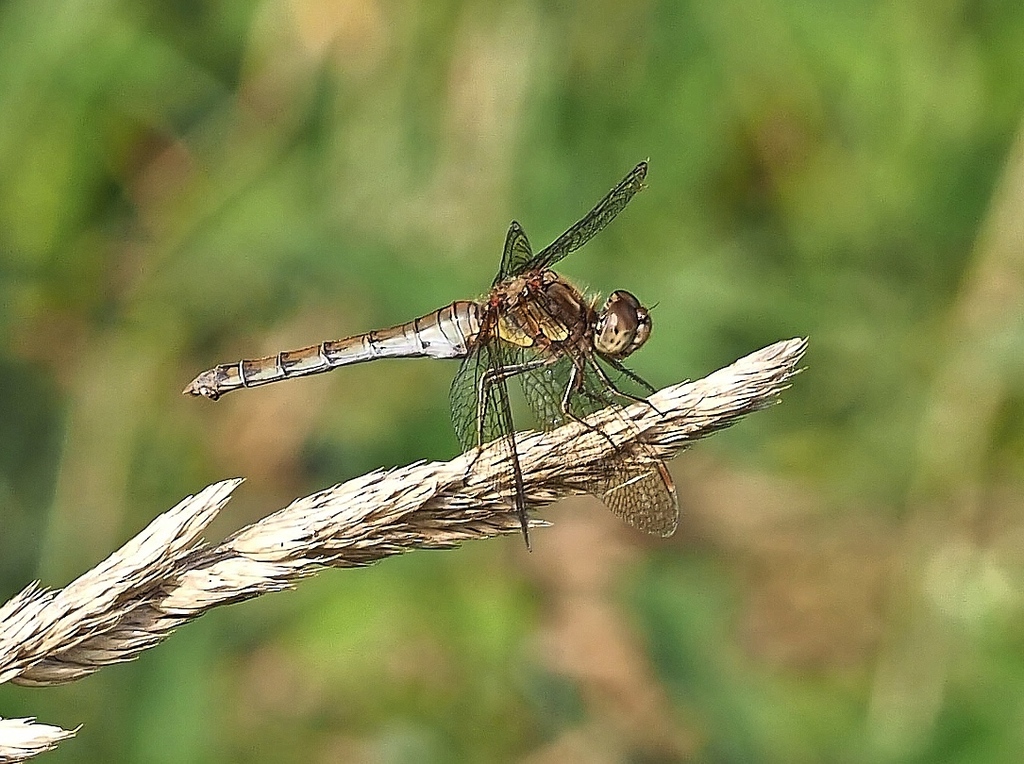
The common darter (Sympetrum striolatum) is a small dragonfly, about 4 cm long, with a brick-red abdomen in males and a golden-brown one in females. Both sexes have black legs with a clear yellow stripe. It perches on bare ground and twig tips, darts out to catch insects, and returns to exactly the same spot. It flies from late June through to November.
By October, most dragonflies are gone. The common darter is not. Long after summer dwindles, you will find them perched on warm tarmac, fence wire, and the tips of last year's rushes, glowing brick-red in autumn light and darting out to catch insects that most observers have stopped looking for. Here is how to identify one, find one, and understand the behaviour that gives it its name.
How to identify a common darter dragonfly
The common darter is a medium-small dragonfly: about 4 cm long with a slender, narrowed abdomen and relatively short wings. The key field marks depend on sex:
- Males: the abdomen deepens from orange-yellow in juveniles to brick-red or blood-red in mature adults. The legs are black with a clean yellow stripe running most of their length. The face is yellowish-green.
- Females and immatures: golden-brown to olive on the abdomen, the same yellow-striped black legs. They are consistently mistaken for other darter species, but the yellow leg stripe, combined with the small size and no obvious markings on the wings, usually nails it.
- Wing posture: when perched, the wings are held angled slightly forward and drooped below horizontal, not flat out like larger species. This forward-angled, slightly slumped silhouette is distinctive.
The likeliest confusion species are the ruddy darter (Sympetrum sanguineum), which is deeper crimson, has all-black legs with no yellow stripe, and a distinctly waisted "club" abdomen, and the vagrant darter (S. vulgatum), mainly a visitor. Check the legs first: yellow stripe = common darter.
The perching habit that gives it the name
The common darter is a perch-and-dart hunter. It selects a vantage point, usually somewhere warm and clear of obstruction: bare soil or tarmac, a twig tip, a fence post, a grass stem. From here it monitors an airspace of a metre or two and launches at any insect that crosses it, returning to exactly the same perch after each sortie.
Two enormous compound eyes wrap most of the head, giving nearly 360-degree vision from the perch. When it launches, it is committing to a pursuit computed entirely in those eyes, and it almost never misses. Midges, gnats, small flies and aphids are the usual targets, snapped from the air and consumed on the return to the perch.
The perch itself warms up in sunshine, which is as important as the view. Dragonflies are ectotherms, their flight muscles only work efficiently above a threshold body temperature, and a sun-warmed perch accelerates that warm-up. A common darter on a cold morning will sit for long minutes before its first launch.
Where and when to find common darters
Common darters breed at still and slow water: ponds, canals, ditches, lakes, quiet river margins. The female lays eggs in tandem with the male, dipping the tip of her abdomen to the surface in characteristic repeated bounces.
Outside breeding, they range widely. You may find them on heathland, woodland rides, sunny banks and garden walls, well away from any visible water. On sunny October and November days, common darters are often the only dragonfly flying, late-season individuals that somehow stay active into conditions that have grounded everything else.
Peak season: late July through September in most of Britain. Flight period: late June to November, sometimes December in warm years. They are most reliably found when the sun is strong and the air temperature above about 15 degrees.
If you are also looking at insects at the waterside, the seven-spot vs harlequin ladybird guide covers the other group most likely to be actively hunting aphids in the same margins at this time of year.
What "Kaught Rare" means for a common dragonfly
The common darter is the most widely recorded dragonfly in Britain, but in the Kaught catalog it sits at the Rare tier, two diamonds out of four. That is worth understanding.
Kaught's rarity tier reflects how often a species turns up in real field observations from all habitat types, not just specialists' visits to dragonfly ponds. Dragonflies are tied to specific water bodies during breeding and are strongly seasonal, so a quality sighting where you can actually check the leg stripe and wing posture is less common than most people assume. That is the Rare tier: real, rewarding to observe, but not something you trip over every day.
Three things worth knowing about the common darter
- The compound eyes that cover most of the head give near-360-degree vision, seeing in ultraviolet as well as visible light. The dragonfly tracks a target for a fraction of a second and then moves to intercept it, not chasing but predicting.
- The larval (nymph) stage lives underwater for one to two years, breathing through gills in its rectum and hunting by ambush, an entirely different and equally effective predator to the adult.
- On cool mornings, a common darter will orient its body to point directly at the sun and angle its wings to focus solar radiation onto the flight muscles, a behaviour that amounts to using its own body as a solar collector.
Common darter dragonfly: frequently asked questions
How do I identify a common darter dragonfly?
Males are brick-red with black legs bearing a clear yellow stripe. Females are golden-brown to olive with the same yellow-striped black legs. Both sexes are small, about 4 cm, and perch with wings angled forward and slightly drooped. The yellow leg stripe separates it from the ruddy darter, which has all-black legs.
When do common darters fly?
Late June through to November, occasionally December in mild years. They are one of the last dragonflies on the wing in autumn, often flying on sunny days when other species have finished.
Where do common darters live?
They breed at ponds, ditches, canals and slow rivers. Outside breeding season they range widely onto heathland, garden walls, woodland rides and open ground, wherever sunshine creates a warm perching spot.
Why do common darters keep returning to the same perch?
They are perch-and-dart hunters. The perch gives a clear view of a hunting airspace and warms the body in sunshine. They dart, catch an insect mid-air, and return to the same spot, sometimes within seconds.
How rare are common darters?
In the Kaught catalog the common darter is the Rare tier, two diamonds out of four. Kaught's rarity reflects how often a species turns up in real observations across all habitat types. Dragonflies are strongly seasonal and tied to specific water, so a confirmed sighting is less everyday than a garden bird.
What do common darters eat?
Small flying insects caught in mid-air: midges, gnats, aphids and small flies. They intercept rather than chase, predicting the target's path from near-360-degree compound-eye vision and moving to the collision point.
The next thing you see could be
your first catch.
Kaught is live on the App Store and Google Play. Free to start, and your first catch is one photo away.
Free to start · Live on the App Store and Google Play
Species data, type, rarity tier and measurements, is drawn from the Kaught catalog, built on open biodiversity records from GBIF and iNaturalist. Rarity reflects how often a species is observed in the wild, not its conservation status.